

When visiting European cities, one of the first things tourists notice is the public transport system. During peak times, crowded metro systems and buses can be frustrating, leading many travellers to explore the city on foot instead.
Walking not only helps avoid transport stress but also allows tourists to see more of the city, soak up the local culture and enjoy some fresh air along the way. To determine which European cities are easiest to explore on foot, we analysed the average distance between the five most popular attractions in each location, along with elevation, estimated travel time and step counts.
The results reveal which European cities are the most walkable and which ones may require other forms of transport to get around efficiently.
Key findings:
- Milan, Italy, and Porto, Portugal are Europe’s most walkable cities, scoring 9.9/10 for the low distance between top attractions and moderate elevation level.
- Athens, Copenhagen, Bergamo and Antwerp follow in joint second, with between 5,000 and almost 8,000 steps required to visit the top five attractions by foot.
- Oslo in Norway is Europe’s least walkable city, scoring just 1/10 with the route requiring a ferry transport to complete it.
- Marseille, France and Helsinki, Finland also scored lower (6.0 and 7.1 respectively), with longer walking distances and unrealistic step counts.
Top 10 most walkable cities
From the stylish streets of Milan to historical adventures in Athens, our study has revealed which European cities are best suited for walking, saving money on public transport and allowing tourists to experience more of the city by foot.
| Most walkable cities | |||||||
|---|---|---|---|---|---|---|---|
| Rank | City | Country | Total distance to each attraction (km) | Total elevation gain along the route (m) | Total number of steps | Travel time for all attractions (hours) | Index score |
| =1 | Milan | Italy | 2.5 | 11 | 4,615 | 0:34 | 9.9 |
| =1 | Porto | Portugal | 1.9 | 25 | 5,641 | 0:30 | 9.9 |
| =2 | Athens | Greece | 2.8 | 17 | 5,769 | 0:41 | 9.8 |
| =2 | Copenhagen | Denmark | 4.1 | 5 | 5,897 | 0:56 | 9.8 |
| =2 | Bergamo | Italy | 2.0 | 40 | 7,692 | 0:33 | 9.8 |
| =2 | Antwerp | Belgium | 4.1 | 20 | 7,821 | 0:55 | 9.8 |
| =3 | Nice | France | 4.6 | 16 | 7,949 | 1:08 | 9.7 |
| =3 | Amsterdam | Netherlands | 4.0 | 25 | 8,333 | 0:56 | 9.7 |
| =3 | Lille | France | 3.6 | 31 | 8,590 | 0:50 | 9.7 |
| =3 | Palermo | Italy | 4.9 | 16 | 8,333 | 1:07 | 9.7 |

=1. Milan, Italy

Top five attractions in route order:
- Il Cenacolo (The Last Supper)
- Castello Sforzesco
- Duomo di Milano
- Galleria Vittorio Emanuele II
- I Navigli
Our research found that Milan, Italy, is Europe’s joint first most walkable city. Beginning at the Il Cenacolo, home to Leonardo da Vinci’s The Last Supper, [1] the route continues through the historic Castello Sforzesco, built between 1360 and 1370. [2] From here, it passes Duomo di Milano, the city’s iconic Gothic cathedral and second largest cathedral in the world, [3] before reaching the elegant Galleria Vittorio Emanuele II, the 19th century shopping arcade, home to luxurious boutiques. [4] The route concludes at the canal district of I Navigli. [5]
Our research found that walking between Milan’s five most popular attractions takes 34 minutes, with a total elevation gain of only 11 metres, making it a largely flat and highly walkable route.
=1. Porto, Portugal
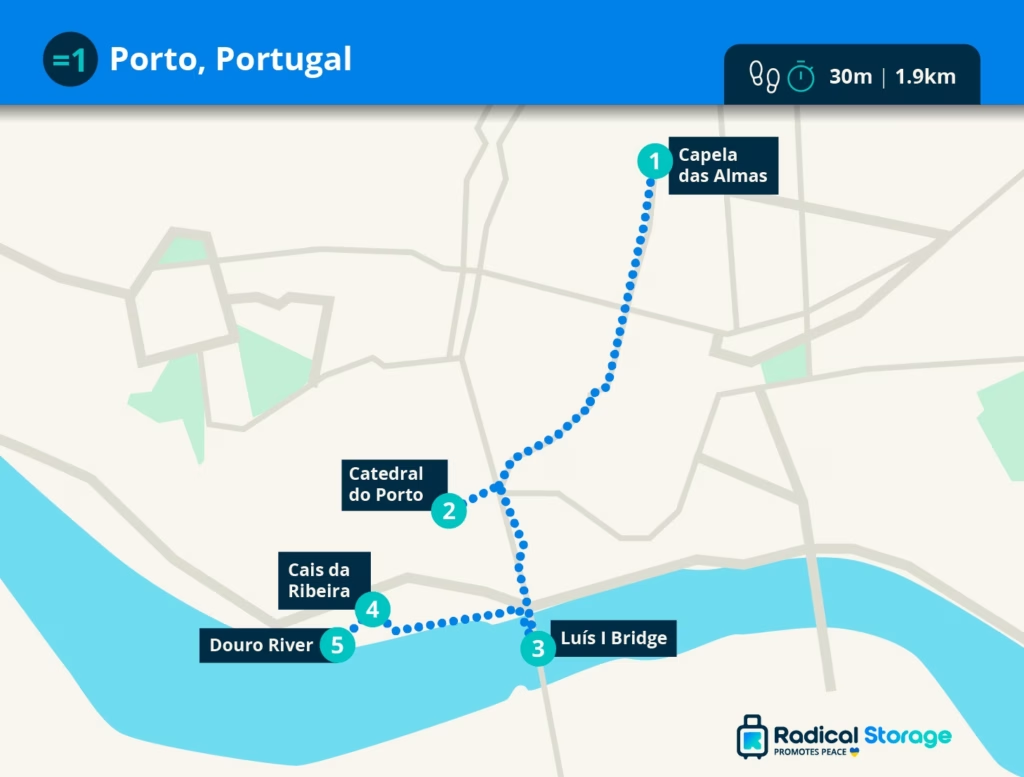
Top five attractions in route order:
- Capela das Almas
- Catedral do Porto
- Luís I Bridge
- Cais da Ribeira
- Douro River
Also in joint first place is Porto, Portugal. Here, the journey to each of the top five attractions is slightly less than Milan, totaling just 1.9 kilometres (30 minutes), but with higher elevation gain (25m), Porto also scored 9.9/10.
Starting at the Capela das Almas, the beautiful blue and white ornate church otherwise known as the Chapel of Souls, [6] the route then takes you to the famous Porto Cathedral. After exploring the historic cathedral, tourists will make their way to Luís I Bridge and the Cais da Ribeira (a popular riverside district packed with cafes and restaurants), [7] and finish their adventure at the Douro River.
=2. Athens, Greece

Top five attractions in route order:
- Acropolis Museum
- Acropolis
- Parthenon
- Plaka
- Panathenaic Stadium
Taking joint second place is Athens in Greece, where it takes just under 45 minutes to walk between the city’s five most popular attractions. While the distances are short, fitness fans will still clock up an average of 5,769 steps along the way, thanks to its elevation gain of 17 metres. With this in mind, it’s a good idea to bring plenty of water and wear comfortable shoes, particularly during the hot summer months, when temperatures average around 29°C in July and August. [8]
Highlights include the Acropolis and Parthenon, which are only a two-minute walk apart, as well as Plaka, the city’s most famous neighbourhood, located right next door. [9] These closely situated landmarks make Athens an excellent city to discover on foot.
=2. Copenhagen, Denmark

Top five attractions in route order:
- Ny Carlsberg Glyptotek
- Tivoli Gardens
- TorvehallerneKBH
- Rosenborg Castle
- Nyhavn
Joint second place also goes to Copenhagen, Denmark, with an overall index score of 9.8 out of 10.
Start your journey in Copenhagen at the Ny Carlsberg Glyptotek followed by the Tivoli Gardens, the historic park filled with charming gardens and rides. [10] After this, visitors then head to TorvehallerneKBH, the city’s bustling food market, ideal for sampling local delicacies, [11] and Rosenborg Castle, home to royal treasures. [12] Complete the route at Nyhavn, the iconic waterfront lined with colourful townhouses and cafés. [13]
Walking between these five attractions covers 4.1 kilometres and takes about 56 minutes. The route has a gentle elevation gain of just five metres and averages 5,897 steps, making it a pleasant and manageable walk.
=2. Bergamo, Italy

Top five attractions in route order:
- Accademia Carrara
- La Città Alta
- Piazza Vecchia
- Basilica di Santa Maria Maggiore
- Funicolare Bergamo Alta
Also in joint second place is Bergamo, Italy, with an overall index score of 9.8 out of 10. Exploring the city’s top five attractions, from the Accademia Carrara to the La Città Alta, Piazza Vecchia, Basilica di Santa Maria Maggiore and Funicolare Bergamo Alta, covers two kilometres and takes about 33 minutes on foot.
However, the route involves an elevation gain of 40 metres, the highest in the top ten locations, and averages 7,692 steps, offering both a compact yet challenging walking experience.
=2. Antwerp, Belgium
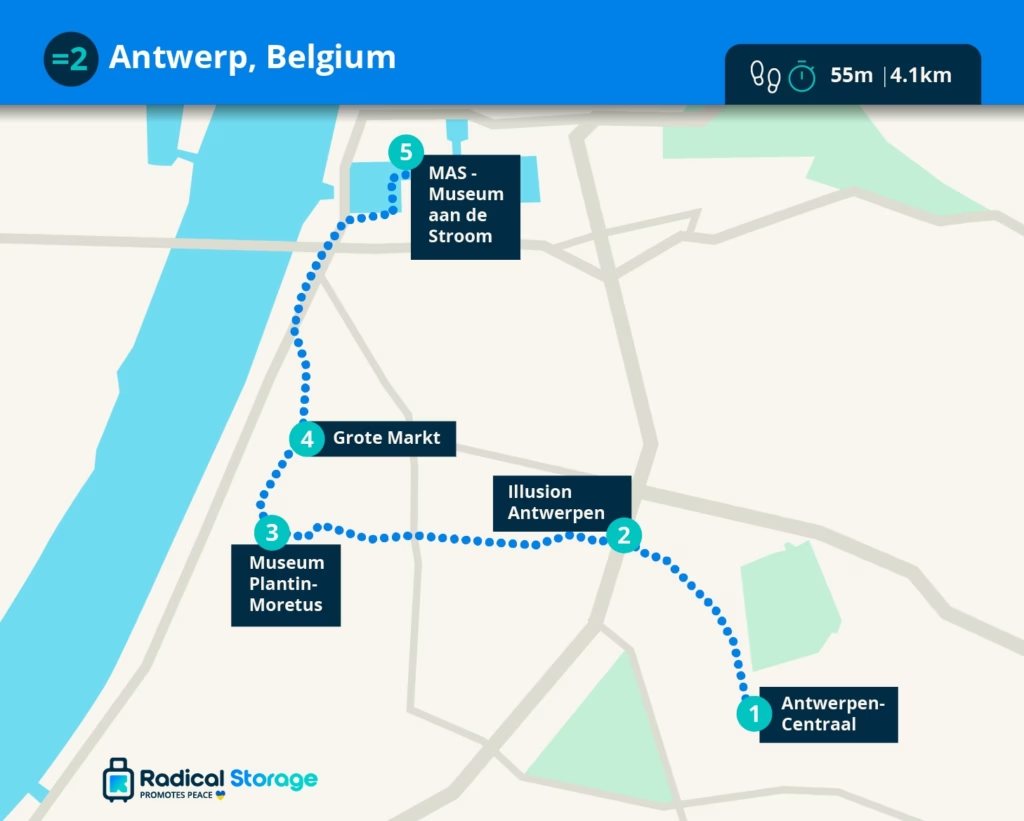
Top five attractions in route order:
- Antwerpen-Centraal
- Illusion Antwerpen
- Museum Plantin-Moretus
- Grote Markt
- MAS – Museum aan de Stroom
Joint second place also goes to Antwerp, Belgium, with an overall index score of 9.8 out of 10. Begin your tour of Antwerp at Antwerpen-Centraal, a beautiful and historic train station, [14] then explore Illusion Antwerpen, a museum of interactive visual exhibits. [15] Next, visit the Museum Plantin-Moretus, a UNESCO World Heritage site celebrating the city’s printing heritage. [16] The route concludes at MAS – Museum aan de Stroom, followed by the historic Grote Markt, home to a variety of restaurants and cafes, and even live music. [17]
Walking between these five attractions covers 4.1 kilometres and takes about 55 minutes. The route involves an elevation gain of 20 metres and averages 7,821 steps, making for a scenic and manageable tour through the heart of the city.
Top 10 least walkable cities
However, not all European cities are easily accessible by foot. As part of the research, we discovered which cities are least walkable, often with long distances between attractions, unrealistic step counts and may even require additional forms of transport to complete the route.
| Least walkable cities | |||||||
|---|---|---|---|---|---|---|---|
| Rank | City | Country | Total distance to each attraction (km) | Total elevation gain along the route (m) | Total number of steps | Travel time for all attractions (hours) | Index score |
| 1 | Oslo | Norway | 97.0 | 588 | 199,744 | 20:12* | 1.0 |
| 2 | Marseille | France | 20.6 | 195 | 51,410 | 4:08* | 6.0 |
| 3 | Helsinki | Finland | 10.3 | 66 | 21,667 | 1:55* | 7.1 |
| 4 | Hamburg | Germany | 13.6 | 6 | 18,205 | 3:05* | 7.3 |
| 5 | Lisbon | Portugal | 13.2 | 130 | 33,590 | 3:06 | 8.6 |
| 6 | Birmingham | UK | 12.5 | 92 | 27,821 | 2:52 | 8.8 |
| =7 | Turin | Italy | 12.0 | 88 | 26,667 | 2:48 | 8.9 |
| =7 | Bordeaux | France | 14.3 | 56 | 25,513 | 3:16 | 8.9 |
| =8 | Prague | Czech Republic | 7.1 | 100 | 21,923 | 1:43 | 9.1 |
| =8 | Toulouse | France | 7.6 | 91 | 21,410 | 1:46 | 9.1 |
*The route requires ferry transport.
1. Oslo, Norway
Top five attractions in route order:
- Fram Museum
- Norsk Folkemuseum
- Vigeland Park
- The Norwegian National Opera & Ballet
- Oslofjord
The research found that Oslo, Norway, ranks as Europe’s least walkable city, scoring just 1 out of 10 in the index. The route will take over 20 hours to complete by foot, far too much for even the most seasoned walkers.
However, if you’re still set on exploring Oslo at your own pace, skipping the Oslofjord could cut the route down to just over two hours, but still seeing plenty of sights. From the Fram Museum to the Norwegian Museum of Cultural History, followed by the Vigeland Park and the Norwegian National Opera & Ballet, Oslo is a great place for cultural and history enthusiasts to explore.

2. Marseille, France
Top five attractions in route order:
- Parc National Des Calanques
- Basilique Notre Dame de la Garde
- Le Vieux Port
- Le Panier
- Château d’If
Marseille, France, ranks as the second least walkable city in our index with a score of 6 out of 10. The route covers 20.6 kilometres and takes over four hours on foot, including a ferry crossing, with an elevation gain of 195 metres and an average of 51,410 steps.
The journey includes Parc National des Calanques, a stunning natural area with cliffs and turquoise waters, [18] Basilique Notre-Dame de la Garde, perched on a hill with panoramic views of the city and coast, the lively Vieux Port harbour, [19] the narrow streets of Le Panier, [20] and concludes at Château d’If, a historic fortress on a small island. [21]
3. Helsinki, Finland
Top five attractions in route order:
- Seurasaaren Ulkomuseo
- Temppeliaukio Church
- Old Market Hall
- Uspenski Cathedral
- Sea Fortress Suomenlinna
Helsinki in Finland ranks as one of the least walkable cities with a score of 7.1 out of 10. If you’re planning on walking between the top five attractions in this city, you can expect to cover 10.3 kilometres and complete the route in about 1 hour 55 minutes, including a ferry crossing. The route involves an elevation gain of 66 metres and averages 21,667 steps, making it a considerably long walk.
However, here you will explore exciting attractions and cultural experiences including the open-air museum of Seurasaaren Ulkomuseo, [22] the unique Temppeliaukio Church carved directly into rock, [23] the bustling Old Market Hall with its local food stalls, [24] the striking architecture of Uspenski Cathedral, [25] and the historic Sea Fortress Suomenlinna. [26]
4. Hamburg, Germany
Top five attractions in route order:
- Planten un Blomen
- Speicherstadt
- Miniatur Wunderland
- Port of Hamburg
- Alter Elbtunnel
In fourth place is Hamburg, Germany, scoring 7.3 out of 10. The route covers 13.6 kilometres and will take just over three hours to complete. However, visitors will need to rely on ferry access in order to complete the route.
The route starts at the Planten un Blomen, a park in the heart of Hamburg, [27] followed by Speicherstadt, the UNESCO site and world’s biggest historic warehouse district. [28] After this, visitors will delight in the Miniatur Wunderland, which is home to the world’s largest model railway, [29] and explore Port of Hamburg before ending the journey at Alter Elbtunnel.
5. Lisbon, Portugal
Top five attractions in route order:
- Calouste Gulbenkian Museum
- Bairro Alto
- Alfama
- Castelo de São Jorge
- Oceanário de Lisboa
Lisbon, Portugal, is among the less walkable cities, scoring 8.6 out of 10. Walking between the top five attractions covers 13.2 kilometres, takes around three hours, has 130 metres of elevation gain, and averages 33,590 steps.
Visitors can admire fine art at the Calouste Gulbenkian Museum, [30] explore the lively nightlife district of Bairro Alto, [31] stroll the winding streets of Alfama, [32] wander the hilltop Castelo de São Jorge with panoramic views, [33] and visit Oceanário de Lisboa, the most visited cultural attraction in Portugal. [34]
6. Birmingham, UK
Top five attractions in route order:
- Cadbury World
- Birmingham Hippodrome
- Birmingham Back To Backs
- National SEA LIFE Centre Birmingham
- Villa Park Stadium
Birmingham in the UK is the sixth least walkable city, scoring 8.8 out of 10. Walking the 12.5 kilometres between its top five attractions takes just under three hours, involves 92 metres of elevation gain, and averages 27,821 steps.
Although the route is realistically too much for one day, the top five attractions include Cadbury World, a chocolate-themed experience perfect for families, [35] the Birmingham Hippodrome, home to theatre and ballet, [36] Birmingham Back to Backs, a preserved historic courtyard showing life in the 19th century, [37] the National SEA LIFE Centre with its interactive marine exhibits, [38] and Villa Park Stadium, the city’s iconic football ground. [39]
The spread-out locations make it a very long walk across the city of Birmingham, and although too much for one day, would make a great adventure for a few days in this city.
Methodology
All data included in this study were collected and are accurate as of December 2025. The locations consisted of the 50 most populous European cities, according to World Population Review. Cities in Russia, Ukraine and Belarus were excluded due to the ongoing conflict.
To assess walkability, the study used Google Maps to measure the walking distances, estimated travel times and elevation gain in meters between the five most popular attractions according to TripAdvisor in each city analysed. Distance (km) and elevation were calculated by using Google Maps Directions and Elevation APIs using geocoded coordinates. Routes were optimised for efficiency to minimise backtracking and ensure a realistic walking experience.
Step counts for each route were calculated using an estimation that 2,000 steps equals roughly one mile in distance. [40] The calculations also accounted for elevation changes, with every 1 metre of vertical gain treated as equivalent to 10 metres of horizontal walking effort, providing a more accurate estimate of the physical effort required.
Each location was scored out of a possible ten points for the following metrics:
- Distance in kilometers between each top attraction out of 10
- Elevation gain in meters along the route out of 10
- Total number of steps occurred along the route out of 10
- Estimated travel time to complete route out of 10
Sources
[2] Castello Sforzesco, ‘La storia del Castello’
[3] Milan Tickets, ‘Your Comprehensive Travel Guide to Milan’s Largest Gothic Cathedral | Duomo Milan’
[4] Civitatis Milan, ‘Galleria Vittorio Emanuele II’
[5] Milan Tips, ‘I Navigli district – Milan canals’
[6] Trips Point, ‘Chapel of Souls’
[7] https://www.visitacity.com/en/porto/attractions/cais-da-ribeira
[8] https://www.holiday-weather.com/athens/averages/
[9] https://www.thisisathens.org/neighbourhoods/plaka-guide
[11] https://www.visitcopenhagen.com/copenhagen/planning/torvehallerne-gdk545401
[12] https://denkongeligesamling.dk/en/rosenborg-castle/
[13] https://www.visitcopenhagen.com/copenhagen/planning/nyhavn-gdk474735
[14] https://visit.antwerpen.be/info/centraal-station
[15] https://illusionantwerpen.be/en
[16] https://museumplantinmoretus.be/en
[17] https://denhaag.com/nl/grote-markt
[19] https://www.marseilletourisme.fr/en/places-see/heritage-culture/neighborhoods/old-port/
[21] https://www.chateau-if.fr/en
[22] https://www.kansallismuseo.fi/fi/seurasaarenulkomuseo
[23] https://architectuul.com/architecture/temppeliaukio-church
[24] https://www.myhelsinki.fi/places/old-market-hall/
[25] https://www.myhelsinki.fi/places/uspenski-cathedral/
[26] https://suomenlinna.fi/en/
[27] https://www.hamburg.com/visitors/explore/outdoors/planten-un-blomen-19042
[28] https://www.hamburg.com/visitors/sights/architecture/speicherstadt-19324
[29] https://www.miniatur-wunderland.de/
[30] https://gulbenkian.pt/museu/en/
[31] https://www.lisbonportugaltourism.com/guide/bairro-alto.html
[32] https://lisbonlisboaportugal.com/Alfama-Lisbon/Alfama-district-lisbon.html
[33] https://castelodesaojorge.pt/
[34] https://oceanario.pt/o-oceanario/
[35] https://www.cadburyworld.co.uk/
[36] https://www.birminghamhippodrome.com/
[37] https://www.nationaltrust.org.uk/visit/birmingham-west-midlands/birmingham-back-to-backs
[38] https://www.visitsealife.com/birmingham/
[39] https://www.avfc.co.uk/villa-park/
[40] https://www.health.harvard.edu/blog/10000-steps-a-day-or-fewer-2019071117305
