
Have you ever needed a holiday from your holiday? Although a trip away should be a time to recharge and relax, navigating a completely new environment can quickly become stressful. From overcrowded tourist hotspots to confusing public transport, we’ve considered 30 indicators of anxiety and analyzed 85,238 reviews of tourist attractions in the 100 most travelled to cities around the world.
This is an update to our original study, first published in 2024. With a new set of reviews collected in March 2026, we revisit the same 100 cities to see what has changed, which destinations have improved, and where anxiety among tourists is on the rise.
Considering the percentage of all reviews that indicate anxiety, we can reveal the most – and least – stressful holiday destinations.
Key findings:
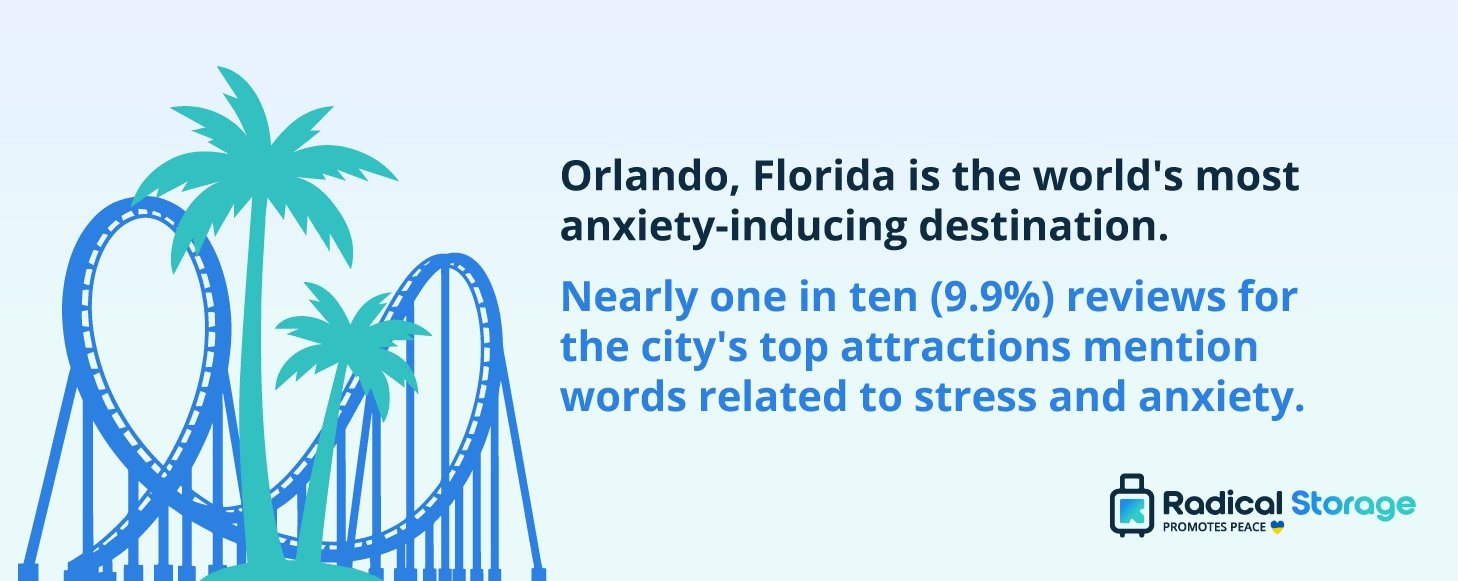
- Orlando, Florida tops the list as the world’s most stressful destination, with nearly one in ten (9.9%) reviews flagging anxiety.
- Tokyo has made the biggest improvement since the study was last run in 2024 of any city, dropping 17.8% from first place to joint fifth (25.2% to 7.4%).
- Japan previously held the top three spots outright. This year none appeared in the top four, with Osaka seeing the second biggest improvement in the study (down 17.4%).
- India features in the top five for the first time, with both Mumbai (7.7%) and Delhi (7.5%) placing in the most anxiety-inducing cities.
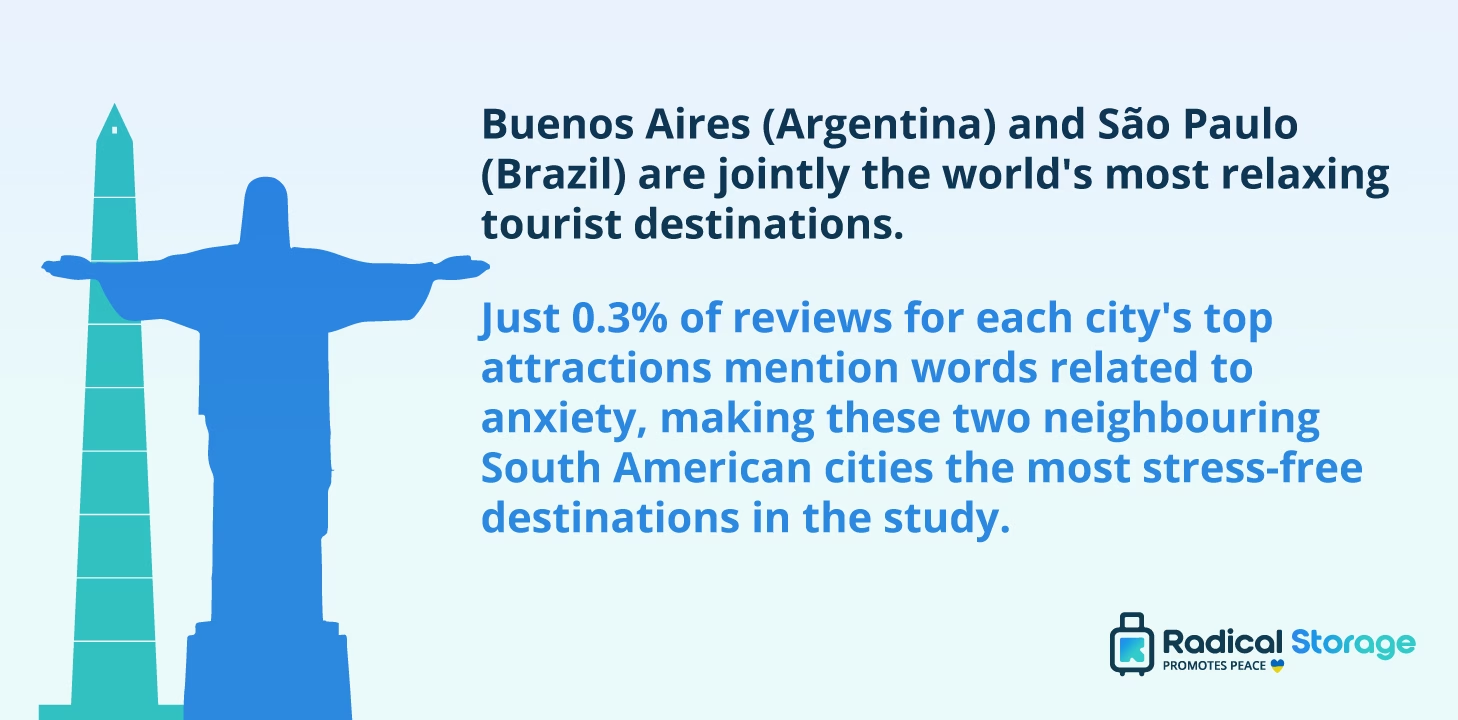
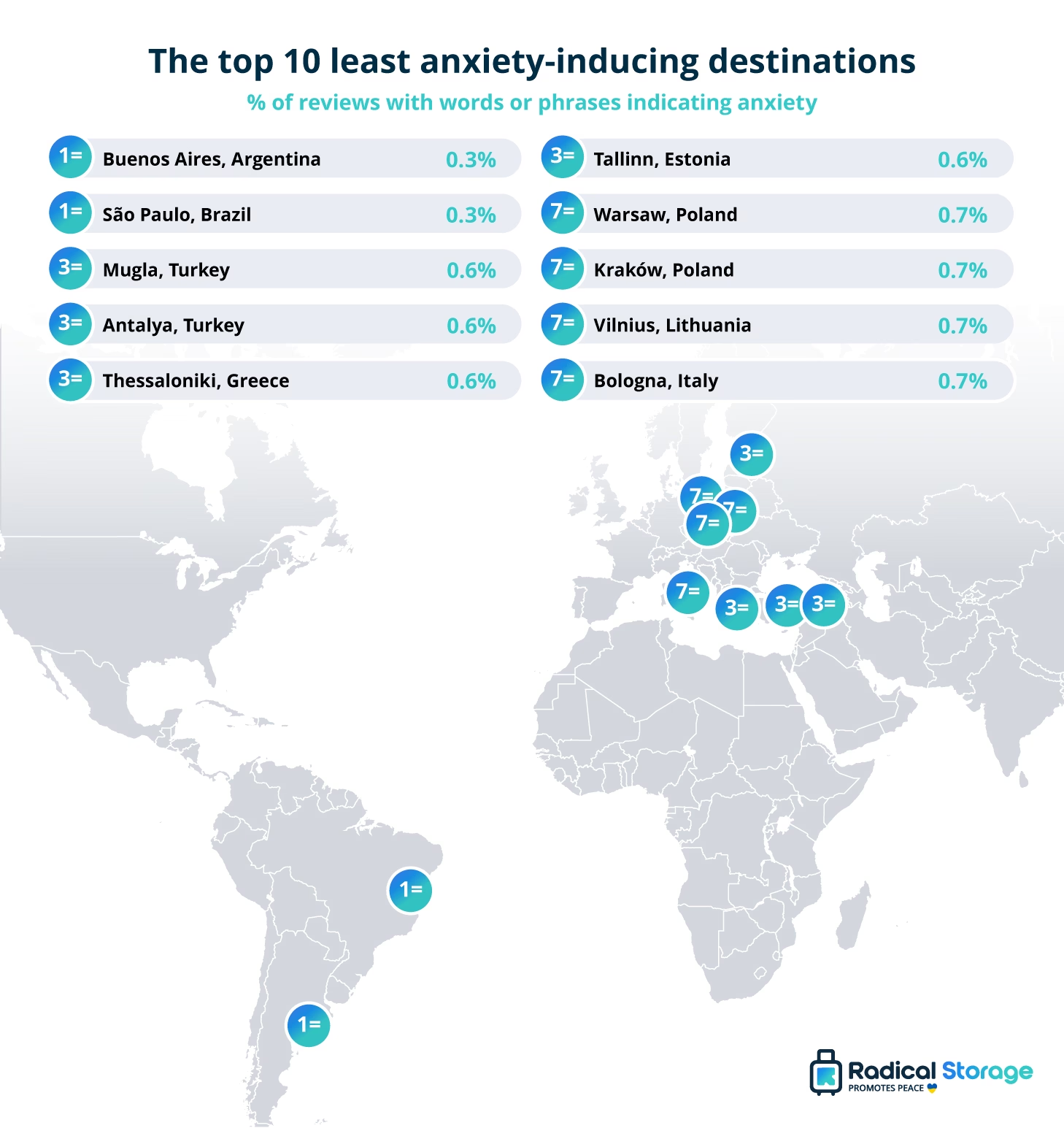
- Buenos Aires and Sao Paulo are jointly the world’s most relaxing destinations, with just 0.3% of reviews flagging anxiety and stress.
- Tallinn, which topped the relaxing list last time, has actually improved further (1.6% to 0.6%) but is now joined by six other cities at that level.
- Europe’s most iconic cities are becoming less stressful: Paris dropped from 14.9% to 2.4%, Rome from 14.2% to 3.5%, and Prague from 15.2% to 3.4%.
The most anxiety-inducing tourist destinations
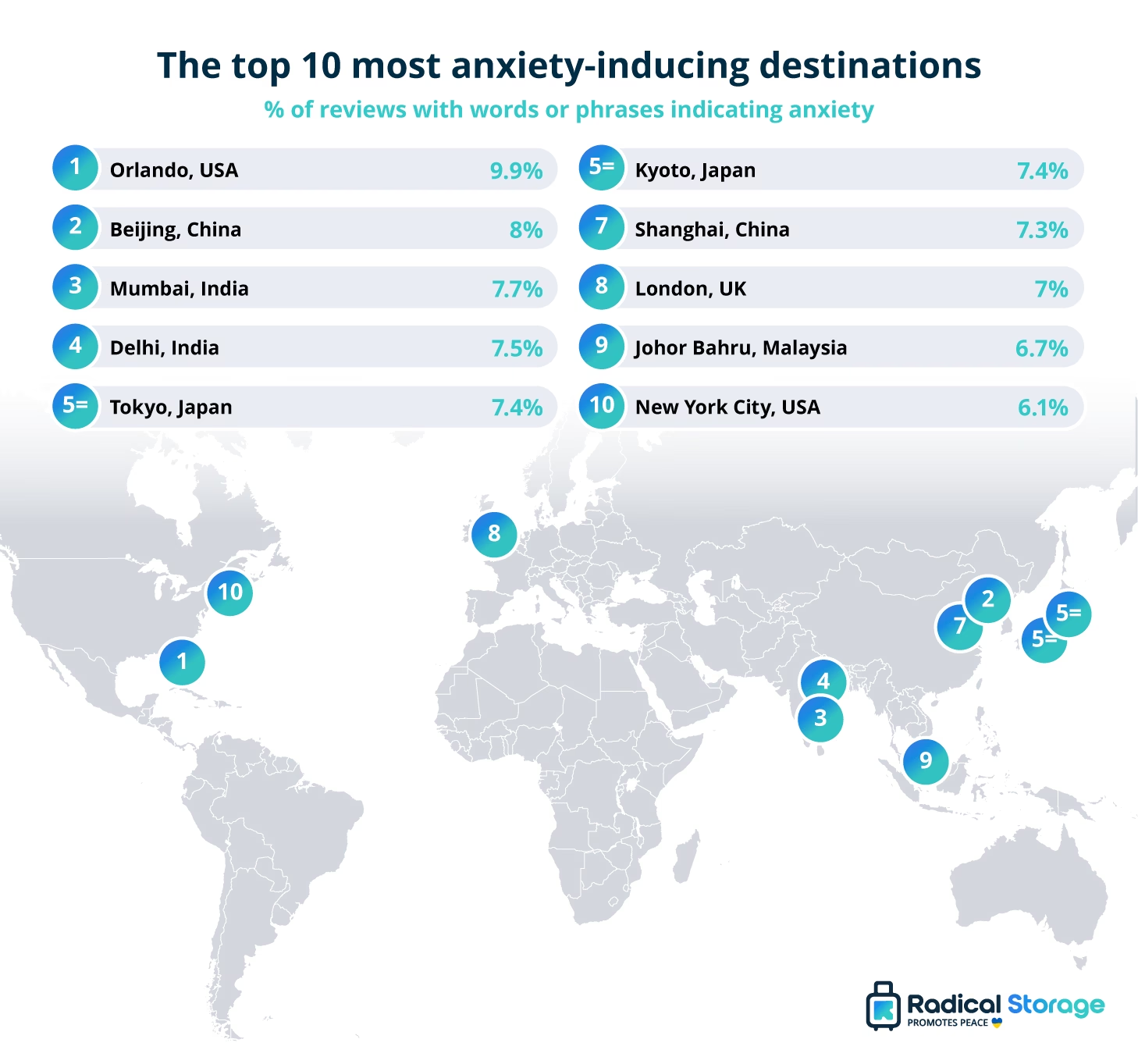
After significant improvements from Japanese cities, which dominated the top three in our previous study, this year’s rankings look very different. Here are the 20 destinations where tourists are most likely to feel the pressure.
| The most anxiety-inducing destinations according to reviews | |||
|---|---|---|---|
| Rank | City | Country | Anxiety in reviews (%) |
| 1 | Orlando | USA | 9.9% |
| 2 | Beijing | China | 8% |
| 3 | Mumbai | India | 7.7% |
| 4 | Delhi | India | 7.5% |
| 5= | Tokyo | Japan | 7.4% |
| 5= | Kyoto | Japan | 7.4% |
| 7 | Shanghai | China | 7.3% |
| 8 | London | UK | 7% |
| 9 | Johor Bahru | Malaysia | 6.7% |
| 10 | New York City | USA | 6.1% |
| 11 | Hong Kong | China | 6% |
| 12 | Singapore | Singapore | 5.9% |
| 13 | Honolulu | USA | 5.5% |
| 14 | Phuket | Thailand | 5.3% |
| 15= | Macau | China | 5.1% |
| 15= | Toronto | Canada | 5.1% |
| 17= | Florence | Italy | 5% |
| 17= | Melbourne | Australia | 5% |
| 19 | Las Vegas | USA | 4.9% |
| 20 | Bangkok | Thailand | 4.8% |
The main cause of stress on holiday is overcrowding, as the most frequent keywords found in the study were ‘crowds’, ‘busy’, and ‘overwhelm’ respectively. Unfortunately, it seems that many of the popular destinations are victims of their own success.
1. Orlando, U.S.
For the first time, a U.S. city tops the list as the most stressful, with Orlando having nearly one in ten (9.9%) reviews mentioning words and phrases related to stress and anxiety. Over half (56.6%) of these negative reviews explicitly commented on the crowds that gather and 17.2% mentioned that it’s busy.
Home to 15 of the world’s top theme parks and water parks, Orlando is one of the most visited destinations in the United States, and the sheer scale of that popularity creates real pressure for visitors on the ground. The city averages around 206,000 visitors per day across the year, rising to above 250,000 during peak summer and holiday periods. [1]
With so many competing attractions to cover and crowds that swell relentlessly during school holidays, the logistical demands of a trip to Orlando can quickly overtake the fun.
2. Beijing, China
Beijing ranks second with 8% of reviews mentioning anxiety-related language. The appeal is easy to understand with Beijing being home to seven UNESCO World Heritage Sites, the highest number of any city in the world, drawing visitors with everything from the Forbidden City and the Great Wall to the Temple of Heaven. The city received 328.5 million visitors in 2023, averaging around 900,000 per day, the vast majority of them domestic tourists travelling during national holidays that create intense seasonal peaks. [2]
Even some of the positive reviews with five stars still allude to the busyness of attractions such as The Forbidden City, and despite many labelling it “worth it”, the crowds are mentioned often.
3. Mumbai, India
Mumbai takes third place with 7.7% of reviews flagging stress. The city draws visitors for a remarkably wide range of reasons: its historical landmarks, Bollywood-driven entertainment, and modern infrastructure make it one of India’s most varied tourist destinations, appealing to everyone from history enthusiasts to film fans.
Mumbai’s famous suburban rail network, often described as the lifeline of the city, carries far more passengers than it was ever designed to handle, and for visitors unaccustomed to the intensity, it can quickly become one of the most overwhelming parts of the trip.
4. Delhi, India
Delhi follows closely at 7.5%, down from 11.4% in our previous study, and makes it the second Indian city to feature in the top five.
As India’s capital and the gateway to the wider Golden Triangle circuit with Agra and Jaipur, it draws visitors with Mughal history, UNESCO-listed monuments, and street food culture. The city received 1.83 million international arrivals in 2023, nearly double the figure recorded in 2022, showing how quickly the Indian hub is growing. [3]
5= Tokyo, Japan
Tokyo’s appearance at joint fifth represents one of the most striking shifts in this year’s study. In our previous research, Tokyo ranked as the world’s most stressful destination, with one in four reviews (25.2%) flagging anxiety-related language. That figure has now fallen to 7.4%, a drop that points to real progress in managing one of the world’s most intense tourism environments.
In 2024, international visitors to Japan reached a record 36.87 million, a 47.1% increase on the previous year, making the improvement in Tokyo’s anxiety score all the more significant given the continued growth in footfall. Japan’s government allocated JPY 15.82 billion in emergency measures to prevent and mitigate overtourism, and Tokyo has increasingly been folded into a nationwide strategy that includes real-time crowd monitoring, limits on tour buses in residential streets, and more active oversight of short-term rentals. [4] The city’s famous Shibuya district, previously cited by visitors as a major source of stress, has been a particular focus of local congestion measures. [5]
5= Kyoto, Japan
To understand how significant Kyoto’s position is this year, it helps to look back. Japan held the top three positions outright in our previous study, with Tokyo first (25.2%), Osaka second (21.6%) and Kyoto third (21.5%). This year none of the three appear in the top four, and Kyoto and Tokyo sit jointly at fifth with 7.4% each, a drop of 14.1% for Kyoto alone.
The three cities have increasingly been brought into the same conversation, now working within a shared national framework that allows for locally tailored responses, including limits on tour buses in residential streets, crowd management in major stations, and more active oversight of short-term rentals.
For Kyoto, that has meant some of the most visible interventions of any city in the study: rising accommodation taxes, time-specific restrictions in popular districts, and access bans on private streets in the Gion geisha district. Kyoto still ranks among the most anxiety-inducing destinations in this study and the pressure on its most famous sites during peak season remains real. But the data suggests the framework is working, and visiting Japan’s most celebrated cities is becoming a measurably less anxious experience. [5]
The least anxiety-inducing cities to visit
One of our studies found that three-quarters of U.S. workers (77%) are planning a vacation in 2024 to combat work stress. The following locations are the best options if you want to choose a destination to help you unwind rather than remain hyper-vigilant and on edge.
1= Buenos Aires, Argentina
Buenos Aires takes joint first place as the world’s most relaxing tourist destination, with just 0.3% of reviews flagging anxiety-related language.
The appeal of Argentina’s capital is well established: tango, world-class steak, European-influenced architecture and a prominent cultural scene. Buenos Aires has plenty of attractions and things to do with theatres, bookshops and museums, it has also been repeatedly voted the best destination in Latin America. The majority of visitors (84%) come for the museums and cultural scene, while 64% are drawn by the food. [6]
Its neighbourhoods spread that footprint naturally across the city, and Argentina welcomed 6.6 million international tourists in 2024, with Buenos Aires the primary destination for the majority of them. That volume, distributed across a large and varied city, appears to translate into a visitor experience that rarely tips into overwhelm.
1= Sao Paolo, Brazil
Another South American city leads the way as the least anxiety-inducing city, this time in the neighbouring country of Brazil. Sao Paulo matches Buenos Aires with just 0.3% of reviews flagging anxiety, jointly the lowest figure in the study.
Where Buenos Aires is defined by leisure tourism, Sao Paulo stands out more for business travel than recreational tourism. The city hosts 90,000 annual events including more than 400 trade shows, and its cultural offering is equally vast, with 101 museums, 282 cinemas, 182 theatres and around 40 cultural centres. That mix, spread across one of South America’s largest cities, means tourist congestion rarely builds in the way it does in cities higher up this list. [7]
2= Second place was shared by four cities from Greece to Turkey
Four cities share second place, each with just 0.6% of reviews flagging anxiety. They span three countries and very different types of destination, but a common thread runs through most of them: they sit outside the most heavily trafficked tourist circuits, where visitor numbers are more evenly distributed and infrastructure is rarely pushed to its limits.
Tallinn is perhaps the most notable name on the list. In our previous study it held the title of the world’s most relaxing destination outright, and while three cities have joined it at this level, it remains one of Europe’s most consistently stress-free city breaks, with reviewers continuing to describe it as unhurried and serene. Previously with 1.6% of reviews flagging as anxiety-inducing, it’s actually significantly improved from last year (to 0.6%), only this time, competing cities have also improved. Some visitors highlight that convenient bag lockers in Tallinn help them combine city tours with shopping trips.
Thessaloniki in Greece offers a Mediterranean pace and rich food scene without the concentrated footfall of Athens, which ranks considerably higher in our study at 2.6%.
Antalya and Mugla, both on Turkey’s Mediterranean coast, benefit from a resort-style visitor spread across beaches, marinas and historic sites, avoiding the single-point congestion common in city-based destinations.
The most improved destinations
After updating our study, we noticed an astounding pattern of Japanese cities leading on improvements. The three cities, Tokyo, Kyoto and Osaka went from the three most anxiety-inducing destinations in the world, to the most improved in the space of two years.
Tokyo tops the improvement table with a 17.8% reduction, followed by Osaka (17.4%) and Kyoto (14.1%).
Europe dominates the rest of the table with Paris improving by 12.5%, Barcelona by 12.1% and Palma de Mallorca by 12%, while Prague (11.8%) and Venice (11.3%) also feature in the top 15. Madrid and Istanbul round out the top ten with improvements of 11.1% and 10.8% respectively.
Rome has seen a notable improvement, with anxious reviews falling by 10.7%, matching London, which despite still ranking among the top seven most anxious cities has also shown a significant year-on-year reduction.
| Rank | City | Country | 2026 % | 2024 % | Improvement |
|---|---|---|---|---|---|
| 1 | Tokyo | Japan | 7.4% | 25.2% | 17.8% |
| 2 | Osaka | Japan | 4.2% | 21.6% | 17.4% |
| 3 | Kyoto | Japan | 7.4% | 21.5% | 14.1% |
| 4 | Paris | France | 2.4% | 14.9% | 12.5% |
| 5 | Barcelona | Spain | 2.3% | 14.4% | 12.1% |
| 6 | Palma de Mallorca | Spain | 1.1% | 13.1% | 12% |
| 7 | Prague | Czech Republic | 3.4% | 15.2% | 11.8% |
| 8 | Venice | Italy | 3.5% | 14.8% | 11.3% |
| 9 | Madrid | Spain | 1.7% | 12.8% | 11.1% |
| 10 | Istanbul | Turkey | 1.6% | 12.4% | 10.8% |
| =11 | Rome | Italy | 3.5% | 14.2% | 10.7% |
| =11 | London | United Kingdom | 7.0% | 17.7% | 10.7% |
| 13 | Phuket | Thailand | 5.3% | 15.6% | 10.3% |
| 14 | Lisbon | Portugal | 2.1% | 12.3% | 10.2% |
| 15 | Marrakech | Morocco | 4.3% | 14.3% | 10% |
Methodology
The latest data was collected in March 2026, updating the previous study from September 2024 using the same methodology. To keep the study consistent the same 100 cities from Euromonitor’s 2023 Top 100 City Destinations Index list from the first study were used. This report compares 55 metrics across six key pillars for 100 city destinations, to create an overall city attractiveness score. The six key pillars include: (1) economic and business performance, (2) tourism performance, (3) tourism infrastructure, (4) tourism policy and attractiveness, (5) health and safety, and (6) sustainability.
For each city, we identified “Things to Do in X”, including popular landmarks and tourist attractions, based on visitor numbers and cultural significance. From these locations, we collected reviews, resulting in a total of 85,238 reviews.
Any city with less than 400 reviews for the top 10 tourist attractions in the city were discounted from the list.
The reviews were then analysed using a custom-built algorithm designed to detect specific anxiety-related keywords. To ensure the accuracy of the analysis, false positives were deducted, for example, distinguishing between words like “traffic” and phrases such as “not much traffic” or “no traffic.” Words with * denote stem words where relevant suffixes were also counted, e.g. overwhelm would also include overwhelming and overwhelmed.
Additionally, false negative keywords were removed to further refine the keyword list, allowing us to measure the presence of anxiety-related sentiments in the reviews across these cities and locations. Finally, we calculated the percentage of reviews containing anxiety-related keywords for each city, allowing us to compare anxiety levels across different cities and attractions.
Keywords:
- Crowded
- Busy
- Traffic
- Overwhelm*
- Worry
- Not crowded
- Noise*
- Pressure
- Stress*
- Exhaust*
- Rushed
- Chaotic
- Disturb*
- Uncomfortable
- Fear
- Tense
- Tiring
- Claustrophobic*
- Unsafe
- Not Busy
- Hectic
- Frustrating
- Nervous
- Unpredictable
- Panic
- Difficult to navigate
- Anxious
- Anxiety
- Uneasy
- Apprehensive
- Restless
- Irritating
- No traffic
- Not hectic
Sources
- Hotelagio. “Orlando Tourism Statistics,” https://hotelagio.com/orlando-tourism-statistics/.
- Road Genius. “Beijing Tourism Statistics,” https://roadgenius.com/statistics/tourism/china/beijing/.
- CEIC Data. “India Visitor Arrivals: Foreigner: Delhi,” https://www.ceicdata.com/en/india/non-resident-visits-by-states/visitor-arrivals-foreigner-delhi.
- World Economic Forum. “How Japan is Redesigning Tourism to Benefit Local Communities,” https://www.weforum.org/stories/2025/05/how-japan-is-redesigning-tourism-to-benefit-local-communities/.
- The Traveler. “Tokyo, Kyoto and Osaka Align on Tough New Overtourism Targets,” https://www.thetraveler.org/tokyo-kyoto-and-osaka-align-on-tough-new-overtourism-targets/.
- GoWithGuide. “Tourism in Buenos Aires Statistics 2024: The Ultimate Guide,” https://gowithguide.com/blog/tourism-in-buenos-aires-statistics-2024-the-ultimate-guide-5716.
- GL events. “São Paulo,” https://www.gl-events.com/en/sao-paulo.

This work is licensed under a Creative Commons Attribution-ShareAlike 4.0 International License.
