

London, Paris, Rome. These capital cities are on many people’s bucket lists. But by bee-lining to a nation’s largest city, are tourists overlooking what else the country has on offer? Is the biggest city always the best city to visit?
To find out, we compared the tourist experience in the most populated city in each European country to its second most populated city (which we refer to as the “second city”). The study assessed how each city performed in five categories: accommodation, food, shopping, culture and local attractions, and accessibility (including the destinations and number of airlines served at the nearest major airport). In each category, multiple factors (such as quality, quantity, and price) were considered.
Key findings:
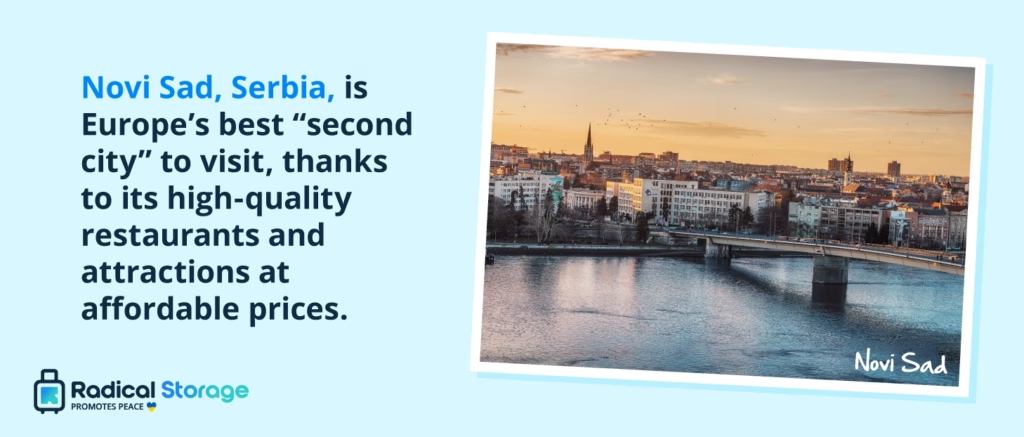
- Novi Sad, Serbia, is Europe’s best “second city” to visit (thanks to its high-quality restaurants and attractions at affordable prices).
- Up-and-coming: Three of the top 10 “second-city destinations” are in the Balkans.
- The second and third best “second cities” for travel are Barcelona, Spain, and Gyumri, Armenia.
- Overall, the second-largest city was the better tourist destination in 10 of the 44 European countries analysed.
- In 28 of the 44 cases, the second city was more affordable than the largest city.
The top 10 best second cities for travel in Europe
Considering all 44 second-cities in the index, which came out top when considering the five factors (accommodation, food, attractions and culture, shopping, and accessibility)?
Geographically, as you can see from the map below, the top-performing cities are spread across the continent. The Balkans performed particularly well, with three cities in the top 10, including the winner, Novi Sad in Serbia. Besides these cities, two top-10 entries can be found in the Caucasus region (in the far east of Europe), two central European cities, two southern European cities, and one eastern European city.

| The top 10 second cities in Europe | |||
| Rank | Country | City | Score out of 10 |
| 1 | Serbia | Novi Sad | 5.87 |
| 2 | Spain | Barcelona | 5.75 |
| 3 | Armenia | Gyumri | 5.72 |
| 4 | Romania | Cluj-Napoca | 5.59 |
| 5 | Bosnia and Herzegovina | Banja Luka | 5.51 |
| 6 | Georgia | Kutaisi | 5.48 |
| 7 | Lithuania | Kaunas | 5.47 |
| 8 | Czechia | Brno | 5.39 |
| 9 | Portugal | Porto | 5.38 |
| 10 | Austria | Graz | 5.32 |
1.Novi Sad, Serbia
Novi Sad in Serbia already has some impressive credentials: it was the European Youth Capital of 2019, and became a UNESCO Creative City in 2023. Now, it can also claim the title of the best second city in Europe to visit.
Visitors to the vibrant city of Novi Sad can expect to find laneway bars in the pretty old town, colourful street art, a 17th-century fortress, and even a 700-metre-long beach stretching alongside the Danube.
Despite not having a huge variety of four-star and above attractions (102 compared to the study average of 291) or four-star and above eateries (251 compared to the study average of 596), there’s still plenty on offer to keep you busy.
Even putting recommendations aside and “going with the flow”, it’s likely you will have a quality experience in Novi Sad. A majority of attractions (62.6%) and eateries (67.1%) are rated 4-star and above, despite the fact that prices are more affordable than the study average. For example, a main meal per person in an inexpensive restaurant will cost you £7.27 (€8.39), whereas the average study cost is £11.79 (€13.61).
| How Novi Sad Performed Across All Factors | ||
| Factor | Metric | Value |
| Attractions and culture | Number of attractions rated above 4 stars | 102 |
| Percentage of attractions rated above 4 stars | 62.6% | |
| Average entry fee for top attractions | £1.50 / €1.73 | |
| Number of UNESCO sites | 1 | |
| Restaurants | Number of eateries rated above 4 stars | 251 |
| Percentage of eateries rated above 4 stars | 67.1% | |
| Average meal price (mid-range restaurant) | £7.27 / €8.39 | |
| Accomodation | Average review of the top 30 Hotels | 4.5 |
| Average price per night at a mid-range hotel | £29 / €33.47 | |
| Shopping | Number of shopping destinations | 19 |
| Average review of shopping destinations | 4.6 | |
| Accessibility | Distance from the nearest major international airport to the city centre | 50-60km |
| Destinations served | 103 | |
| Airline carriers served | 25 | |
2. Barcelona, Spain
Unlike some of the other second cities in our list, Barcelona is probably already on your travel radar. Tourism is a big business in the city (and, according to some residents, too big). In 2024, the city of 1.7 million residents hosted 15.6 million tourists. [1] And despite protests from locals, it’s no surprise that tourists flock to the Catalan capital year after year. Many visitors note that using bag lockers in Barcelona makes it easier to explore crowded attractions without carrying luggage.
There is something for everyone in Barcelona. Architecture enthusiasts will enjoy the seven UNESCO-recognized Gaudí buildings. Foodies will enjoy tucking into the tapas culture (and enjoying local specialities like salted cod, or the bomba). And music and culture lovers can go traditional, and dance the Sardana, or let their hair down at one of the many music festivals in and around the city (like Primavera).

Barcelona did especially well in the rankings due to the sheer variety of options on offer. After London, Paris, and Rome, the city has the 4th greatest number of four-star and above attractions (2,858) and the 5th most four-star and above eateries (5,649). Considering the distance to the nearest major airport, the number of destinations, and airlines, Barcelona’s airport ranked the second-best for accessibility (joint with Paris, Zurich, and the Spanish capital, Madrid).
| How Barcelona ranked out of each factor | |||||
| City | Culture and local attractions ranking | Restaurant ranking | Accommodation ranking | Shopping ranking | Accessibility Ranking |
| Barcelona | 1st | 4th | 37th | 2nd | 1st |
3. Gyumri, Armenia
Following bustling Barcelona is a more low-key location: Gyumri, in Armenia. Though there may be just 34 attractions with a four-star and above rating, and 52 four-star and above eateries, the quality of the hotels and shops, and affordable prices make Gyumri an attractive destination.
History buffs will appreciate the city’s complex history – and the cheap entrance fees (averaging at £1.50). Gateways into Gyumri’s past include a visit to Abovian Street (preserved from the 19th century), Sev Bed (an abandoned Russian-imperial fortress), and the museum of National Architecture and Urban Life (which has recreated scenes from Armenia’s history).
A hotel room here costs £22 / €25.40 (£75.93 / €87.64 below the study average), and a main meal for one person costs around £7.22 / €8.32 (£4.57 / €5.29 below the study average), allowing for plenty to spend at the few but highly rated shopping locations.
| How Gyumri ranked out of each factor | |||||
| City | Culture and local attractions ranking | Restaurant ranking | Accommodation ranking | Shopping ranking | Accessibility Ranking |
| Gyumri | =20th | 10th | 1st | 4th | 33rd |
4. Cluj-Napoca, Romania
About 400km north of the Romanian capital, Bucharest, lies Cluj-Napoca, Romania’s second most populous city and the historic capital of Transylvania. But due to its affordable prices (amongst other things), the city can also lay claim to being the fourth best second city for European holidaymakers.
Travellers to Cluj-Napoca can flit between medieval landmarks and urban hotspots. Besides the natural beauty of the Botanical Garden or Cetatuia Park, hikers can also explore the nearby Apunseni Mountains or the twisted trees in the Hoia-Baciu Forest.
Looking closely at the figures, what sets Cluj-Napoca apart is the decent selection of four-star attractions (155) and four-star eateries (261) at lower-than-average prices (£5.90 / €6.81 for an entrance fee at a top attraction, and £8.44/ €9.74 for an individual main meal at a mid-range restaurant).
| How Cluj-Napoca ranked out of each factor | |||||
| City | Culture and local attractions ranking | Restaurant ranking | Accommodation ranking | Shopping ranking | Accessibility Ranking |
| Cluj-Napoca | 12th | 15th | 10th | 12th | 10th |
5. Banja Luka, Bosnia and Herzegovina
Again, this smaller city has less variety (for example, just 38 four-star attractions and 74 four-star restaurants). But what Banja Luka lacks in variety, it makes up for in quality. Seven in ten (69.2%) of the eateries are rated as above four stars, the third-highest score of any second city. The average meal costs £6.56 (€7.57), 57% below the study average of £11.79 (€13,61). Hotel prices here are also £27 (€31.17), 113.5% below the average of £97.93 (€113,04).

Previous visitors recommend a walk from the centre up the Banj brdo hill, a visit to the rebuilt Ferhat Pasha Mosque, or the Kastel fortress. Those wanting a taste of Balkan cuisine are advised to try Burek (a pastry often with a savory beef and potato filling) and Cevapi (a grilled dish of mincemeat).
| How Banja Luka ranked out of each factor | |||||
| City | Culture and local attractions ranking | Restaurant ranking | Accommodation ranking | Shopping ranking | Accessibility Ranking |
| Banja Luka | =20th | 3rd | =2nd | 33rd | 36th |
The best second cities per category
Although the study considers a variety of factors to give a holistic view of what each city offers, every individual tourist has their unique preferences when travelling. Some people are looking for a holiday for their taste buds, whilst for others a trip abroad is an opportunity to load their suitcases with some unique souvenirs and mementos.
Below, you can find out which “second cities” performed best per category.
Accommodation
For tourists who value comfort, choosing a quality hotel is paramount – and even better if the hotel bill doesn’t cost the earth. The study considered both the quality of the top 30 hotels advertised on TripAdvisor and the average cost for an overnight stay for a standard double room.
The top three destinations for accommodation:
- Gyumri, Armenia
- Average review of top 30 hotels: 4.7
- Average cost of a one-night stay at a mid-range hotel: £22/€25.40
2. Banja Luka, Bosnia and Herzegovina
- Average review of top 30 hotels: 4.6
- Average cost of a one-night stay at a mid-range hotel: £27/€31.17
3. Nikšić, Montenegro
- Average review of top 30 hotels: 4.6
- Average cost of a one-night stay at a mid-range hotel: £27/€31.17
Food and drink
Food-tourism (making food and drink a central part of your holiday plans) is increasing in popularity. [2] To create a foodie rating for each city, the number of eateries above four stars was considered, and the percentage of all eateries above four stars, too. The cost of a mid-range meal at a restaurant was also considered.
The top three destinations for restaurants:
- Nikšić, Montenegro
- Number of eateries rated four-star or above: 28
- Percentage of all eateries that are four-star or above: 73.7%
- Cost of a meal at a mid-range restaurant: £5.97/€6.89
- Bitola, North Macedonia
- Number of eateries rated four-star or above: 26
- Percentage of all eateries that are four-star or above: 66.7%
- Cost of a meal at a mid-range restaurant: £4.16/€4.80
- Banja Luka, Bosnia and Herzegovina
- Number of eateries rated four-star or above: 74
- Percentage of all eateries that are four-star or above: 69.2%
- Cost of a meal at a mid-range restaurant: £6.56/€7.57
Shopping
If you’re looking for an opportunity to treat yourself (and loved ones) on holiday, we’ve got you covered. The study considered the number of shopping destinations listed on TripAdvisor for each city and the average rating for these destinations out of five.
The top three shopping destinations:
- Milan, Italy
- Number of shopping destinations: 849
- Average review of shopping destinations: 4.2
- Barcelona, Spain
- Number of shopping destinations: 784
- Average review of shopping destinations: 4.2
- Porto, Portugal
- Number of shopping destinations: 315
- Average review of shopping destinations: 2.4
Culture and local attractions
For curious travellers and those wanting to immerse themselves in the local culture, checking off a “bucket list” of attractions and sites to see might be high on the list of priorities. The study considered the number of tourist attractions rated over four stars, the percentage of all attractions rated over four stars, and the average cost of entry to the top attractions to gauge the quantity, quality, and affordability of activities on offer.
The top three destinations for culture and local attractions:
- Barcelona, Spain
- Number of tourist attractions rated four-star and above: 2858
- Percentage of all tourist attractions rated four-star and above: 49%
- Average cost of entry to a popular tourist attraction: £26.70/€30.83
- Number of UNESCO protected sites: 2
- Graz, Austria
- Number of tourist attractions rated four-star and above: 172
- Percentage of all tourist attractions rated four-star and above: 44.6%
- Average cost of entry to a popular tourist attraction: £10.40/€12.01
- Number of UNESCO protected sites: 4
- Bitola, North Macedonia
- Number of tourist attractions rated four-star and above: 17
- Percentage of all tourist attractions rated four-star and above: 63%
- Average cost of entry to a popular tourist attraction: £1.90/€2.19
- Number of UNESCO protected sites: 1
Accessibility
But what good is a cool location if you can’t even get there? Because the second cities are smaller than the main cities of each country, transport links may be a little less straightforward. The study considered the distance from the nearest major airport (serving more than 20 destinations) and the number of destinations flying to and from the airport, and the number of airline operators.
The top three most accessible destinations:
- Barcelona, Spain
- Distance from the nearest major international airport to the city centre: 10-15km
- Destinations served: 218
- Airlines served: 82
- Geneva, Switzerland
- Distance from the nearest major international airport to the city centre: 1-10km
- Destinations served: 142
- Airlines served: 57
- Milan, Italy
- Distance from the nearest major international airport to the city centre: 45-50km
- Destinations served: 205
- Airlines served: 87
64% of the countries’ best second cities were cheaper than the first
To compare affordability, the researchers summed the average cost of a meal at a mid-range restaurant, the average cost of a ticket to a popular attraction, and the average hotel price for one night.
Overall, in 28 of the 44 countries analysed, the second city was more affordable than the first city. The notable cases where this wasn’t true were in the Republic of Moldova (where Chișinău is 56.87% cheaper than Bălți), Cyprus (where Nicosia is 55.18% cheaper than Limassol), and Spain (where Madrid is 54.76% cheaper than Barcelona).

Below are the ten cities where the second city is more affordable than the main city. In the Netherlands, where left luggage Amsterdam services are popular with travelers, the price gap of around £100/€115,43 comes largely from hotel costs, with Amsterdam charging far more than nearby Rotterdam. A similar story plays out in Denmark, where Copenhagen is pricier than Aarhus, though visitors often make use of secure lockers in Copenhagen to explore the city more freely.
| The top 10 cities with more affordable second cities | ||||||||||
| Rank | Country | First city | Price for a hotel night, a meal, and a ticket to an attraction (£) | Price for a hotel night, a meal, and a ticket to an attraction (€) | Second city | Price for a hotel night, a meal, and a ticket to an attraction (£) | Price for a hotel night, a meal, and a ticket to an attraction (€) | Difference (£) | Difference (€) | Percentage difference |
| 1 | Netherlands | Amsterdam | £243.29 | €280.86 | Rotterdam | £133.18 | €153.74 | £110.10 | €127.10 | 58.49% |
| 2 | Denmark | Copenhagen | £240.40 | €277.52 | Arhus | £158.68 | €183.18 | £98.87 | €114.14 | 51.78% |
| 3 | Montenegro | Podgorica | £52.44 | €60.54 | Nikšić | £34.65 | €40.00 | £17.79 | €20.54 | 40.85% |
| 4 | Georgia | Tbilisi | £47.13 | €54.41 | Kutaisi | £31.37 | €36.21 | £15.76 | €18.19 | 40.15% |
| 5 | France | Paris | £228.46 | €263.74 | Marseille | £154.02 | €177.80 | £74.44 | €85.93 | 38.92% |
| 6 | United kingdom | London | £200.36 | €231.30 | Birmingham | £138.06 | €159.38 | £62.30 | €71.92 | 36.82% |
| 7 | Poland | Warsaw | £103.36 | €119.32 | Lódz | £71.52 | €82.56 | £31.84 | €36.76 | 36.41% |
| 8 | Finland | Tallinn | £117.93 | €136.14 | Tartu | £116.03 | €133.95 | £53.39 | €61.63 | 33.07% |
| 9 | Slovenia | Ljubljana | £101.10 | €116.71 | Maribor | £78.98 | €91.18 | £22.11 | €25.52 | 24.56% |
| 10 | Portugal | Lisbon | £151.72 | €175.15 | Porto | £119.12 | €137.51 | £32.60 | €37.63 | 24.07% |
The 10 countries with superior “second cities”
So, when planning a trip to a new European country, are you really better off bee-lining to the second-largest rather than the largest city? Although this study helps shine a light on various “hidden gems” for a low-key getaway, larger cities are generally set up better for tourists. However, comparing all the metrics, the second city performed better than the first city in 10 countries.
Below is the complete list of the 10 European countries where the second city ranked higher than the first:
| Countries where the second-largest city is better for tourists | ||||||
| Country | First city | Overall score | Second city | Overall score | Difference between first and second city | |
| 1 | Romania | Bucharest | 5.23 | Cluj-Napoca | 5.59 | -0.36 |
| 2 | Andorra | Andorra la Vella | 4.70 | les Escaldes | 4.96 | -0.26 |
| 3 | Liechtenstein | Schaan | 3.78 | Vaduz | 4.03 | -0.25 |
| 4 | Switzerland | Zürich | 4.13 | Geneva | 4.36 | -0.23 |
| 5 | Austria | Vienna | 5.11 | Graz | 5.32 | -0.21 |
| 6 | Norway | Oslo | 4.42 | Bergen | 4.62 | -0.20 |
| 7 | Serbia | Belgrade | 5.68 | Novi Sad | 5.87 | -0.19 |
| 8 | Armenia | Yerevan | 5.72 | Gyumri | 4.70 | -0.15 |
| 9 | Slovenia | Ljubljana | 4.96 | Maribor | 5.05 | -0.09 |
| 10 | Georgia | Tbilisi | 5.45 | Kutaisi | 5.48 | -0.04 |
Methodology
The study compiled a list of the most and second-most populated cities in 44 European countries according to World Population Review. The study excluded Russia due to its involvement in the full-scale conflict in Ukraine. Ukraine’s Kharkiv originally ranked 9th in the second-city index; regretfully, both Kharkiv and Kyiv city had to be excluded from the final rankings due to the ongoing conflict in the country and the barriers this presents to tourism.
The data for the individual metrics was sourced as follows:
- The average rating and price for an overnight stay at a mid-range hotel were taken from booking.com
- The average price of a meal at a mid-range restaurant was taken from Budget your Trip and Numbeo. The entry fees for popular attractions were also taken from Budget your Trip.
- The total number of restaurants, including four-star and above rated restaurants, and the total number of attractions, including four-star and above rated attractions, were taken from TripAdvisor. The number of shopping destinations and their average rating was also taken from TripAdvisor.
- The number of UNESCO sites was taken from UNESCO
- An accessibility score was calculated by considering three metrics equally. The distance to a major airport (serving more than 20 destinations) was taken from Google Maps. And the number of destinations served and airlines operating at the airport was taken from FlightsFrom.
All data was collected in June and July 2025. Currency was converted via Google Finance on 23/07/2025.
Sources
[1] Lonely Planet, ‘Lonely Planet’s guide to navigating overtourism in Barcelona’, 2025
[2] The Travel Psychologist, ‘What is food tourism and why is it growing in popularity?, 2024

This work is licensed under a Creative Commons Attribution-ShareAlike 4.0 International License.
