
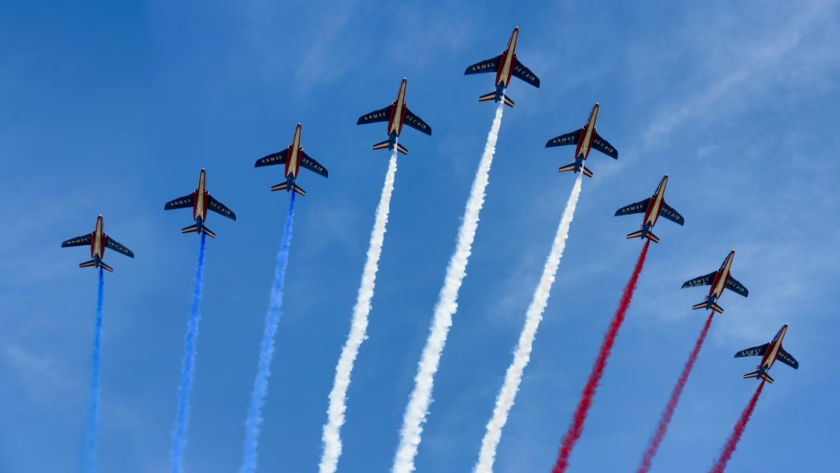
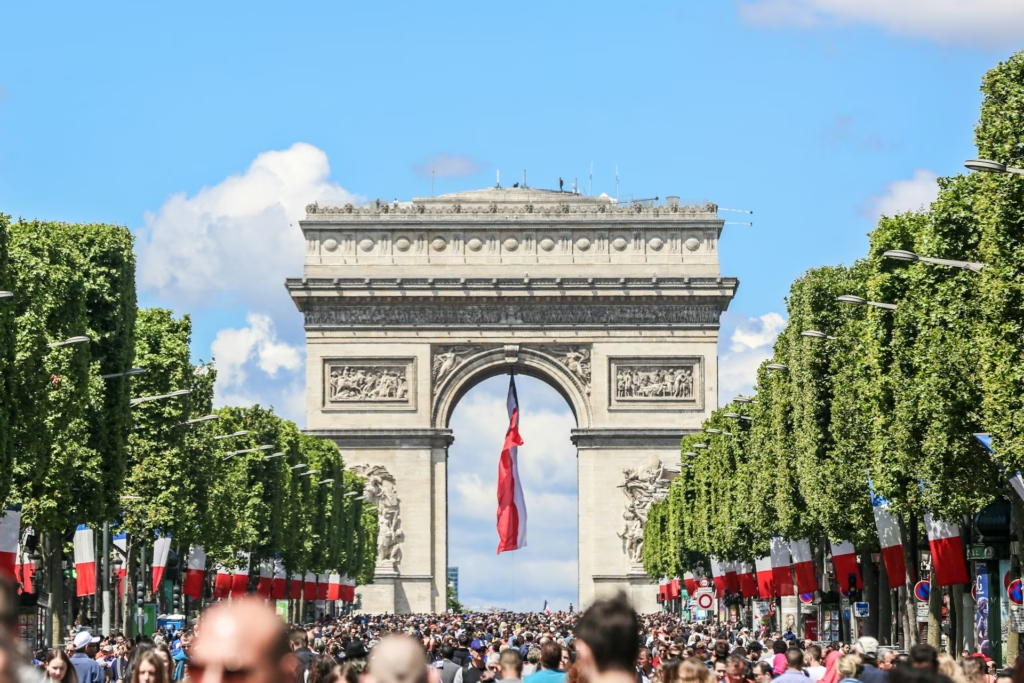
Bastille Day 2026 falls on Tuesday, 14 July — France’s national holiday, La Fête Nationale, and one of the great free spectacles in Europe. In Paris, it means a grand military parade down the Champs-Élysées from the Arc de Triomphe to Place de la Concorde, a flyover of French Air Force and Navy aircraft, an evening concert at the Champ de Mars, and a fireworks display launched from the Eiffel Tower, Iéna Bridge, and the Trocadéro Gardens starting at 11pm. The full day runs from early morning ceremony to well past midnight — and all the main events are free to attend.
What Is Bastille Day 2026?
La Fête Nationale commemorates the storming of the Bastille fortress on 14 July 1789, a defining moment of the French Revolution that symbolised the people’s uprising against royal authority. It has been a French national holiday since 1880. Today it is marked across every town and city in France with parades, concerts, bals populaires (public dances), and fireworks — with Paris hosting the largest and most formal celebrations in the country.
The name “Bastille Day” is primarily used in English. In France the day is simply called le 14 juillet or La Fête Nationale.
Bastille Day 2026: Day at a Glance
| Time | Event | Location |
|---|---|---|
| ~10:00am | Presidential ceremony at Arc de Triomphe | Arc de Triomphe |
| ~10:00am–noon | Champs-Élysées military parade | Arc de Triomphe → Place de la Concorde |
| ~10:25am | Military aircraft flyover | Over central Paris |
| Afternoon | Free time, local celebrations, bals des pompiers begin | Citywide |
| Evening | Open-air concert on Champ de Mars | Champ de Mars |
| ~9:10pm | Classical music and opera concert, Eiffel Tower base | Champ de Mars |
| 11:00pm | Fireworks display begins | Eiffel Tower, Iéna Bridge, Trocadéro |
| ~11:30pm | Fireworks end (approx. 30 minutes) | — |
| From 9:00pm | Bals des Pompiers continue until 4am | Fire stations citywide |
The Bastille Day Military Parade on the Champs-Élysées
The centrepiece of Bastille Day in Paris is the Grand Military Parade — Europe’s largest annual military parade, and one of the oldest.
The parade begins with a ceremony at the Arc de Triomphe at approximately 10am, where the President of the French Republic presides over tributes at the Tomb of the Unknown Soldier. The formal procession then moves down the Champs-Élysées towards Place de la Concorde, covering roughly 2km. The parade typically includes around 7,000 troops from various branches of the French armed forces — infantry, cavalry, armoured vehicles, the Republican Guard on horseback — as well as invited contingents from allied nations.
At approximately 10:25am, the aerial flyover takes place: around 60–65 military aircraft including Rafale jets and the Patrouille de France aerobatic team trail blue, white, and red smoke across the Paris sky. The full parade lasts approximately two hours.
The 2026 Parade Route
The parade follows the standard Bastille Day route, confirmed as returning to the Champs-Élysées. (The 2024 parade was relocated to Avenue Foch due to the Paris Olympics; the Champs-Élysées parade returned in 2025 and continues in 2026.)
| Segment | Location |
|---|---|
| Opening ceremony | Arc de Triomphe |
| Parade route | Avenue des Champs-Élysées heading southeast |
| End point | Place de la Concorde |
| Distance | Approximately 2km |
| Start time | ~10:00am |
| Duration | Approximately 2 hours |
The parade is broadcast live on France 2 television and on France TV’s streaming platform for those who prefer to watch from a distance.
Where to Stand for the Parade
The Champs-Élysées fills up very early on 14 July. If you want a position along the barriers, arrive by 7am at the latest — many regulars arrive earlier. The avenue is wide and the crowds are deep, but the further towards Place de la Concorde you stand, the thinner the crowds tend to be compared to the Arc de Triomphe end.
If you want to watch the aerial flyover without the crowd pressure, large open spaces like the Jardins des Tuileries and the Esplanade des Invalides offer clear sightlines to the sky without being blocked by tall buildings.
Metro Closures on Bastille Day 2026
Several Paris Métro stations close on the morning of 14 July due to the parade and security requirements, at the request of the Préfecture de Police. Based on the established annual pattern (confirmed each year by RATP), the following stations are typically closed from the start of service through approximately 2pm:
Line 1: Charles de Gaulle–Étoile, George V, Franklin D. Roosevelt, Champs-Élysées–Clémenceau, Concorde, Tuileries
Line 2: Porte Dauphine
Additional lines (6, 8, 9, 10, 13): Stations near the Eiffel Tower and Trocadéro area close later in the day, ahead of the evening concert and fireworks. These include Trocadéro, Bir-Hakeim, La Motte-Picquet–Grenelle, École Militaire, and Invalides, among others.
RER C: Pont de l’Alma, Champ-de-Mars–Tour Eiffel, and Invalides typically close in the afternoon/evening.
Bus and tram routes across central Paris are diverted or suspended throughout the day. Vélib’ bike stations in the 7th and 8th arrondissements are also partially suspended.
The Métro and RER trains otherwise run on extended hours on the night of 14–15 July. Noctilien night buses operate for late-returning crowds. Always check the RATP website (ratp.fr) in the days before 14 July for confirmed 2026 closures, as the exact list is published ahead of the event.
The Bastille Day 2026 Fireworks at the Eiffel Tower
The Paris fireworks display is the signature moment of the night. Launched from the Eiffel Tower itself, the Iéna Bridge, and the Trocadéro Gardens, the show starts at 11pm and lasts approximately 30 minutes. It is produced by Groupe F, the company behind many of France’s major pyrotechnic events, and is accompanied by a live musical soundtrack.
The Eiffel Tower is closed to visitors on 14 July due to preparations for the fireworks. It reopens on 15 July.
Best Places to Watch the Paris Fireworks
| Viewing Spot | Distance from Tower | Notes |
|---|---|---|
| Champ de Mars | Directly behind the tower | Most popular; arrive by 4pm for a clear spot |
| Trocadéro Gardens | Directly in front (across the Seine) | Excellent frontal view; extremely crowded by mid-afternoon |
| Pont d’Iéna | Between Champ de Mars and Trocadéro | Very close to launch points; fills fast |
| Quai Branly / Seine riverbanks | Near the tower | Good side views; some standing room until early evening |
| Palais de Chaillot terraces | Trocadéro area | Elevated view across to the tower |
| Anywhere with an Eiffel Tower view | Throughout Paris | Many quieter spots exist across Montmartre, Belleville, and beyond |
All of these viewing areas are free. The Trocadéro and Champ de Mars are the most crowded and require arriving several hours before the 11pm start. For a more relaxed experience, dozens of other Paris vantage points offer clear views of the display.
Seine dinner cruises are a popular option for Bastille Day fireworks: departures from various Paris quays from around 7:30–8pm, with the fireworks viewed from the water at 11pm. These require advance booking, often months ahead.
Bastille Day Celebrations Beyond the Parade and Fireworks
The Firemen’s Balls (Bals des Pompiers)
One of the most authentically Parisian Bastille Day experiences is the Bal des Pompiers — the firemen’s balls held at fire stations across the city on the evenings of 13 and 14 July. Stations open their courtyards and host public dances with live music, bars, and a genuine neighbourhood atmosphere. Entry is free or costs a token amount depending on the station. The balls run from around 9pm until 4am and are genuinely popular with locals. Stations in the 3rd, 4th, 5th, 11th, and 12th arrondissements are traditionally among the liveliest. No tickets are required — walk in.
The Champ de Mars Evening Concert
On the evening of 14 July, the Champ de Mars hosts a free open-air concert throughout the early evening hours. At approximately 9:10pm, a special classical music and opera concert takes place at the base of the Eiffel Tower, featuring the French National Orchestra and the Radio France Choir. This concert is also broadcast live on France Inter radio and France 2 television.
Celebrations Across France
Every French city and town marks 14 juillet with local fireworks and bals populaires. Notable celebrations outside Paris include:
- Lyon: Fireworks over the Rhône and Saône rivers
- Marseille: Display over the Vieux-Port
- Bordeaux: Fireworks along the Garonne waterfront
- Carcassonne: One of France’s most dramatic fireworks shows, launched from the medieval walls of the Cité — considered by many the finest outside Paris
- Nice: Fireworks over the Promenade des Anglais and the Baie des Anges
How to Get Around Paris on Bastille Day
Walking is the most reliable way to move around central Paris on 14 July. Road closures, metro station shutdowns, and the sheer volume of people make vehicles impractical.
Taxis and rideshare services are extremely difficult to find in the evening, particularly anywhere near the Eiffel Tower, Champs-Élysées, or Seine. Do not rely on them for getting home after the fireworks.
The Métro runs extended hours on the night of 14–15 July but is very crowded, particularly after 11:30pm when the fireworks end. The lines that are operational (outside the closed stations) will be packed. Give yourself extra time and expect delays.
The authorities partially suspend bike stations near the Eiffel Tower and the Champs-Élysées on the day, but cycling via Vélib’ bike-share offers a practical option for reaching the fireworks viewing zones. Check availability in advance.
Luggage Storage in Paris on Bastille Day
If you’re arriving in Paris on 14 July itself — flying in, taking the Eurostar from London, or arriving by train from elsewhere in France — Bastille Day is one of the worst days in the year to be dragging luggage across the city. The authorities close metro stations, block streets, and form dense crowds, while hotel check-in times rarely align with a 10:00am parade.
Radical Storage has luggage storage locations across Paris including near major train stations and tourist hubs, open every day of the year. Drop your bags before the parade, spend the day hands-free, watch the fireworks from the Champ de Mars, and collect your luggage when you’re ready. All bags are covered by included insurance.
Practical Tips for Bastille Day 2026 in Paris
For the parade: Arrive by 7am for a position along the barriers. Bring water and sun protection — July in Paris is warm and you may be standing in direct sun for several hours. Security is strict; travel as light as possible and expect bag checks.
For the fireworks: The Champ de Mars and Trocadéro Gardens fill up by mid-afternoon. Arrive by 4pm at the latest for a good spot. Bring a picnic — it is a long wait, and it is what Parisians do.
Keep your valuables secure. Bastille Day draws some of the largest crowds of the year in Paris. Pickpockets are active in both the parade crowds and fireworks zones. Keep phones and wallets in front pockets and minimise what you carry.
After the fireworks: Getting home after 11:30pm is genuinely difficult. The authorities reopen the nearest metro stations to the Eiffel Tower gradually after the display, but passengers face very crowded trains. Walking 20–30 minutes to a less congested station is often faster than waiting in line at Trocadéro or Bir-Hakeim.
The Eiffel Tower is closed on 14 July. If visiting the tower is part of your trip, plan it for 13 July or 15 July.
Museums and attractions: Some Paris museums offer free or reduced entry on 14 July, and many are less crowded in the afternoon once attention shifts to the evening celebrations. The Louvre, Musée d’Orsay, and national museums are worth checking.
Frequently Asked Questions
The Paris fireworks display starts at 11pm on 14 July, launched from the Eiffel Tower, Iéna Bridge, and the Trocadéro Gardens. The show lasts approximately 30 minutes.
The Champ de Mars (behind the tower) and the Trocadéro Gardens (facing the tower across the Seine) are the two main viewing areas. Both are free and fill up by mid-afternoon. Arrive by 4pm for a reasonable spot.
Yes. The 2026 parade follows the standard Champs-Élysées route from the Arc de Triomphe to Place de la Concorde, starting at approximately 10am. (The organizers relocated the 2024 parade to Avenue Foch for the Olympics, but the procession returned to the Champs-Élysées route in 2025.)
Yes. The military parade, the flyover, the Champ de Mars concert, the fireworks, and the bals des pompiers are all free. The only costs are food, drink, and any paid experiences such as dinner cruises or restaurant seats.
Yes. Radical Storage operates luggage storage locations across Paris every day of the year, including 14 July. Prices start from €4.90 per bag per day. Book at radicalstorage.com.
Final Thoughts
Bastille Day 2026 in Paris is one of Europe’s great free public spectacles. The Champs-Élysées parade, the flyover, the evening concert, and the Paris fireworks over the Eiffel Tower are each extraordinary on their own — together across one day they make 14 July one of the best days of the year to be in the city. The key to enjoying it is simple: arrive early for whichever event you want to see, travel light, plan your metro route before the closures kick in, and store your luggage if you don’t need it with you. The rest takes care of itself.