

In the 1960s, 70s, and 80s, package holidays (where holiday accommodation and transportation were sold together in a ‘package’) provided customers with an affordable and accessible opportunity to travel abroad. But by 2012, interest in package holidays had fallen off so sharply that travel experts warned the sector could go “extinct”. [1]
However, the package holiday, and its big brother the ‘all-inclusive’ holiday (where food, drink, and entertainment are also included), have made a comeback. Since 2018, bookings to all-inclusive resorts have doubled every three to four years. [2] But who is most likely to go on an all-inclusive holiday? And is the “fly and flop” stereotype really true? We surveyed 1,050 holidaygoers about their experiences on all-inclusive holidays (compared to other holiday types) to find out.
Key findings
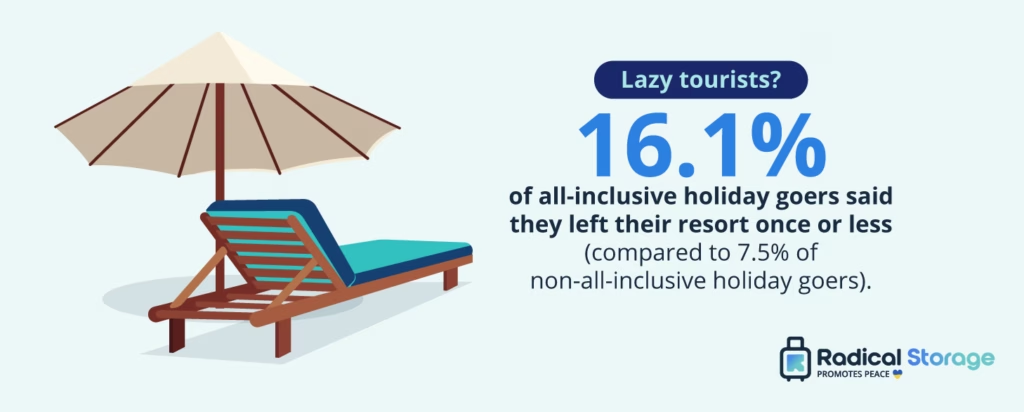
- Lazy tourists? 16.1% of all-inclusive holidaygoers said they leave their resort once or not at all (compared to 7.5% of non-all-inclusive holidaygoers).
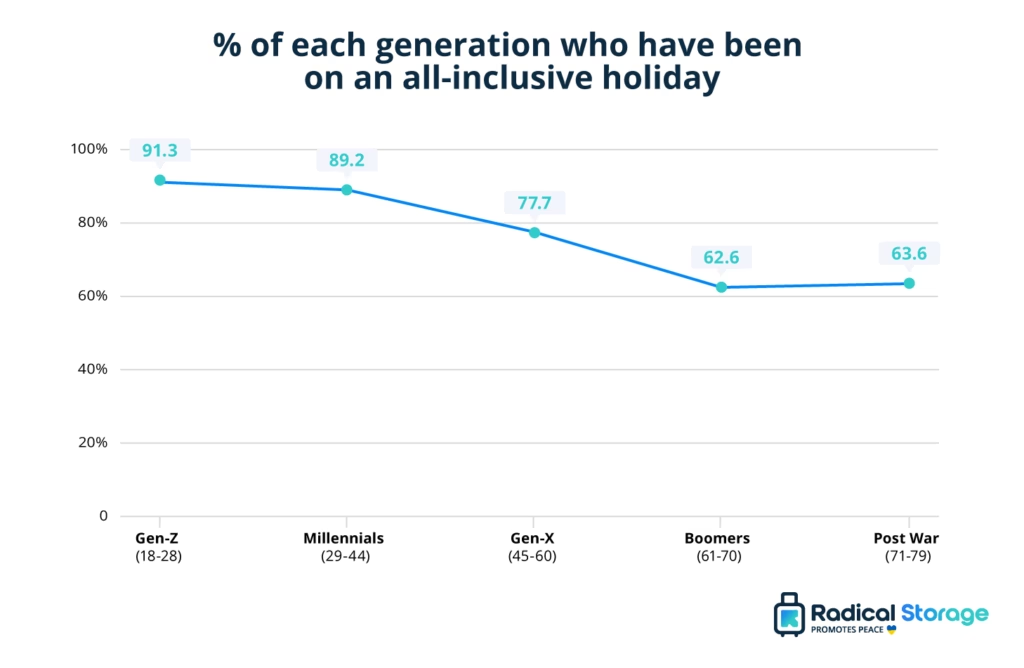
- Younger generations favour all-inclusive holidays: Gen-Z are the most likely to go on an all-inclusive holiday (91.3%), and boomers are the least likely (62.6%).
- The White Lotus Experience: 97.6% of respondents earning £100,000-£124,999 have been on an all-inclusive holiday, whereas the study’s lowest earners are the least likely to (58.6%).
- The “fly and flop” myth: all-inclusive holidaygoers are only slightly less likely to engage with local culture than other holidaygoers.
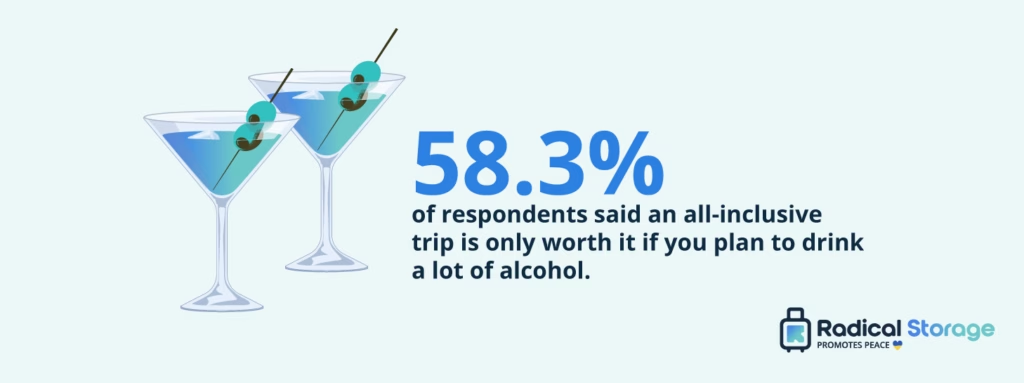
- Boozy getaways: 58.3% of respondents said an all-inclusive trip is only worth it if you plan to drink a lot of alcohol.
- Holidayers on an all-inclusive trip are more likely to eat more (6.4 compared to 5.7 out of 10), drink more alcohol (6 compared to 5.4 out of 10), “dress up for dinner” (5.8 compared to 5.2), and make a friend (4.2 compared to 3.9.
- You are more likely to try local food (6.4 compared to 6.1 out of 10), explore the surrounding area (5.9 compared to 5.6), and use the local language (4.9 compared to 4.5) if you are not on an all-inclusive holiday.
Who is going on all-inclusive holidays?
Overall, the majority (80.6%) of respondents said that they had been on an all-inclusive holiday (where all meals, drinks, and activities were included in the price). However, some demographics were far more likely than others to have been on this kind of trip.
Digging into the demographics, there was only a slight gender difference in who had gone all-inclusive (81.6% of men compared to 79.4% of women). What had a bigger impact on the results were the ages of the respondents. Despite having had less life experience, Gen-Z (aged 18-28) were still the most likely to have taken an all-inclusive trip (91.3%). This is 28.7% greater than the rate of Boomers (aged between 61-79), who were the least likely to have been on this type of getaway (62.6%).
One argument why package and all-inclusive holidays have found appeal with younger audiences is the influence of shows like Love Island. The popular dating-reality show, where competitors are filmed living in a luxury, catered villa for six to eight weeks, has partnered with Jet2 holidays since 2022 (a provider of package holidays). And interest continues to grow. Since April 2024, Google searches for “Jet2Villas holiday” have increased by 414%.
Wealth, luxury, and the all-inclusive experience
The White Lotus – the Emmy-award-winning HBO series – pulled in an audience of around 18 million for its third season. Every season is set in a different luxury resort or hotel, and interest in the venues featured in the show has skyrocketed. [3] For example, in April 2025 (the month of the 3rd season finale) to a year prior, Google searches for “Four Seasons Resort Koh Samui” (one of the principal filming locations in Thailand) had increased by 1,019%.
On a wider scale, despite “all-inclusive” holidays traditionally being regarded as the economical choice, upscale options are increasing in popularity. The Four Seasons recently launched a holiday package worth a minimum of $188,000, and five-star resorts now offer “infinite lifestyle” packages where guests can indulge in Michelin-star food and 24-hour complimentary room service. [4] [5]
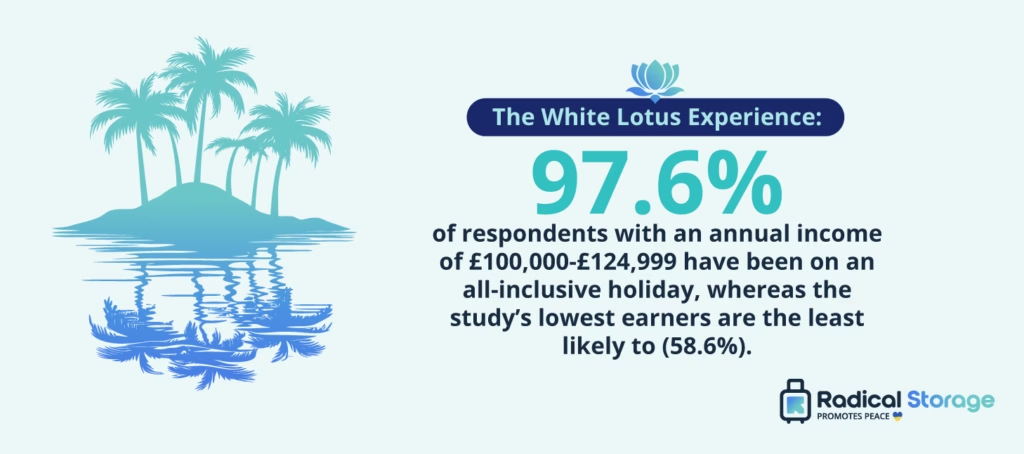
And the findings of the survey also reflect that all-inclusive holiday packages are more popular with wealthier demographics. There was an almost perfect positive correlation between a respondent’s income and the likelihood they had been on an all-inclusive holiday. The most likely (97.6%) to have been on an inclusive holiday were those who earned between £100,000 and £124,999. Meanwhile, the lowest income earners (those earning less than £10,000 annually) were the least likely to have been on an all-inclusive trip (58.6%).
And after villas (which scored an average score of 3.6 out of 5 for luxury), an all-inclusive holiday was considered the next most luxurious holiday type (3.5), joint with a cruise. At the bottom of the scoreboard were hostels (1.5 out of 5) and a caravan holiday (1.8).
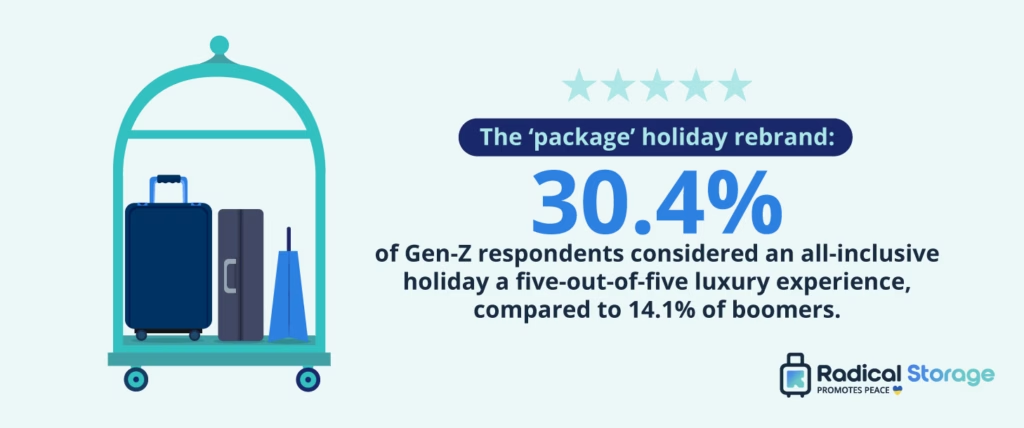
There was a significant generation gap in how an all-inclusive holiday is perceived. Older generations were least likely to consider an all-inclusive holiday as a luxury experience (only 14.1% of Boomers considered it 5 out of 5, and 9.1% of Post-war respondents). Bucking the recent trends seen in pop culture (for example, in Love Island and The White Lotus), 30.4% of Gen-Z respondents considered it a five-out-of-five luxury experience.
| How luxurious respondents considered different holiday types (5 being most luxurious) | |
| Holiday accommodation/type | Average score |
| Villa | 3.6 |
| All-inclusive | 3.5 |
| Cruise | 3.5 |
| Hotel (room only) | 2.9 |
| AirBnB | 2.6 |
| Caravan | 1.8 |
| Hostel | 1.4 |
Fly and flop? What really happens on an all-inclusive holiday
As explored in our study on the world’s most stressful destinations, navigating your way around a new environment can be anxiety-inducing. All-inclusive holidays are convenient: the stresses of finding and booking your own accommodation and the logistics of getting there are taken off your plate. It’s not surprising, then, that guests of all-inclusive holidays were slightly more likely to leave feeling relaxed (7.1) than on other holiday types (6.9).
However, does all this convenience come at its own cost? Does the temptation to “fly and flop” make tourists more likely to miss out on what the local culture has to offer? We asked respondents to rate out of 10 (with 10 being the most likely) how likely they were to do various things on holiday. We also asked respondents to estimate how many days per week they would engage in different activities (e.g., how many times in a week might you explore local nature?).
| Likelihood of activities/outcomes on an all-inclusive getaway compared to other holiday types | |||
| Activity/outcome | Likelihood on an all-inclusive holiday out of 10** | Likelihood on a non-all-inclusive holiday out of 10* | Difference |
| Leave feeling relaxed and recharged | 7.1 | 6.9 | -0.2 |
| Eat more than you would normally at home | 6.4 | 5.7 | -0.7 |
| Eat local foods/dishes | 6.1 | 6.4 | +0.2 |
| Drink more alcohol than you would normally at home | 6.0 | 5.4 | -0.7 |
| ‘Dress up’ for dinner | 5.8 | 5.2 | -0.6 |
| Go on a day trip beyond the local area/city | 5.6 | 5.9 | +0.4 |
| Learn and use words of the local language | 4.5 | 4.9 | +0.4 |
| Make a friend(s) | 4.2 | 3.9 | -0.3 |
| Have a romantic interest | 2.8 | 2.6 | -0.2 |
*Only considering people who have been on a non-all-inclusive holiday type.
**Only considering people who have been on an all-inclusive holiday.
Besides asking how likely (out of 10) a respondent was to participate in a certain activity, the survey also sought to quantify the number of times per week that holiday goers engaged in the different activities (e.g., on 2.4 days of a week-long holiday, someone on an all-inclusive holiday ate a local restaurant, compared to other types of holiday where it was 4.4).
| Average number of days per activity (on a one-week holiday) | |||
| Activity | Days on a non-all-inclusive holiday* | Days on an all-inclusive holiday** | Difference |
| Eat at a local restaurant | 4.4 | 2.4 | 2 |
| Go outside of your resort/accommodation | 5.1 | 3.4 | 1.7 |
| Explore local culture (museum, tours, etc.) | 3.6 | 2.9 | 0.7 |
| Explore attractions or landmarks | 3.7 | 3 | 0.7 |
| Spend time in nature | 3.3 | 2.7 | 0.6 |
| Exercise | 2.5 | 2.3 | 0.2 |
*Only considering people who have been on a non-all-inclusive holiday type
**Only considering people who have been on an all-inclusive holiday.
Food and drink
In our tourist-syndrome survey, we found that 53.1% of respondents admitted to drinking more alcohol on holiday. Binge-drinking on holiday is a common bad habit, and in response, several popular Spanish resorts have introduced a three-drink-per-night limit for tourists. [6]
Often, though, all-inclusive resorts offer customers “unlimited” food and drinks, including cocktails. This doesn’t necessarily guarantee you an infinite supply of margaritas, as there may be limits, like times of day you can and can’t drink. [7]
Still, this temptation of unlimited booze is the winning factor for many. When asked whether they thought all-inclusive holidays were only worth the money if they planned on drinking lots of alcohol, 58.3% of respondents said yes.
Sampling the local cuisine is a holiday highlight for many. Only 3.9% of respondents said there was no chance of them trying local foods whilst on an all-inclusive holiday, and only 2.7% said there was no chance of this on other types of holiday.
However, considering that catering is often part of the package, 12.3% of respondents said they would never eat at a local restaurant on an all-inclusive holiday compared to 3.5% on other holiday types. Taking all answers into consideration, someone staying in an all-inclusive hotel or resort ate at a local restaurant almost half as often as someone not on an all-inclusive holiday.
| Time spent eating at a local restaurant | ||
| Time spent | On an all-inclusive holiday* | On a non-all-inclusive holiday** |
| 0 days/not at all | 12.3% | 3.6% |
| 1 day/once | 20.9% | 10.8% |
| 2 – 3 days/a few times | 48.7% | 25.4% |
| 4 – 6 days/very often | 13.0% | 29.0% |
| 7+ days/every day of my trip | 5.0% | 31.1% |
| Average amount in days | 2.4 | 4.4 |
*Only considering people who have been on an all-inclusive holiday.
**Only considering people who have been on a non-all-inclusive holiday type.
Socialising and engaging with the local culture
The phrase “beach, nap, shower, dinner” has 25.3 million posts on TikTok, and getting ready for a nice meal after a long day lazing in the sun is many tourists’ idea of complete bliss. [8] Getting dressed up for dinner on a holiday – and maybe even posting a “couples fit check” on social media – is part of the fun. The survey found that you were more likely to do this if you were on an all-inclusive holiday (5.8) than on a non-all-inclusive holiday (5.2).
If socialising with others is something you look forward to on holiday, then an all-inclusive holiday is also a better option. You were slightly more likely to leave having made a friend (4.2 compared to 3.9) and even had higher odds of a holiday romance (2.8 compared to 2.6).
But what about engaging with the local culture and stepping out of your comfort zone?
Around 16.1% of all-inclusive holiday goers said they left their resort once or less during a typical seven-week stay, which is twice as high as those on other types of holiday. Overall, the average number of days per week someone on an all-inclusive holiday leaves their resort/accommodation site is 3.4 days per week.
However, this is still less than you would if you were on a non-all-inclusive trip. On a non-all-inclusive holiday, the average respondent spent 5.1 days out and about away from their accommodation. Almost half of the respondents (47.1%) said they typically spent time every day of their trip away from their accommodation, compared to just 14% of those on an all-inclusive holiday.
| Time spent going outside the accommodation | ||
| Time spent | On an all-inclusive holiday* | On a non-all-inclusive holiday** |
| 0 days/not at all | 3.2% | 2.0% |
| 1 day/once | 12.9% | 5.5% |
| 2 – 3 days/a few times | 47.6% | 22.1% |
| 4 – 6 days/very often | 22.3% | 23.3% |
| 7+ days/every day of my trip | 14.0% | 47.1% |
| Average amount in days | 3.4 | 5.1 |
*Only considering people who have been on an all-inclusive holiday.
**Only considering people who have been on a non-all-inclusive holiday type.
Only a minority of guests on an all-inclusive holiday (5.9%) reported spending no time engaging with or learning about the local culture (such as visiting a museum or going on a guided tour).
| Time spent exploring the local culture | ||
| Time spent | On an all-inclusive holiday* | On a non-all-inclusive holiday** |
| 0 days/not at all | 5.9% | 4.7% |
| 1 day/once | 21.0% | 13.4% |
| 2 – 3 days/a few times | 44.3% | 40.7% |
| 4 – 6 days/very often | 19.5% | 23.4% |
| 7+ days/every day of my trip | 9.3% | 17.8% |
| Average amount in days | 2.9 | 3.6 |
*Only considering people who have been on an all-inclusive holiday.
**Only considering people who have been on a non-all-inclusive holiday type.
A respondent was twice as likely to spend every day of their trip exploring local attractions or landmarks on a non-all-inclusive holiday compared to an all-inclusive one (16.8% compared to 7.9%). Overall, taking into consideration all responses, the average difference was slight: coming in at 3 days of a week-long trip for an all-inclusive goer, and 3.7 for other types of holidays.
| Time spent exploring local attractions | ||
| Time spent | On an all-inclusive holiday* | On a non-all-inclusive holiday** |
| 0 days/not at all | 4.8% | 3.0% |
| 1 day/once | 18.4% | 12.3% |
| 2 – 3 days/a few times | 48.3% | 39.6% |
| 4 – 6 days/very often | 20.5% | 28.4% |
| 7+ days/every day of my trip | 7.9% | 16.8% |
| Average amount in days | 3 | 3.7 |
*Only considering people who have been on an all-inclusive holiday.
**Only considering people who have been on a non-all-inclusive holiday type.
Health and wellness
Wellness tourism (travelling to promote or maintain physical or mental well-being) is a booming industry and is projected to be worth $8.5 trillion in 2027. [9] Often, hotels or resorts are equipped with gyms, pools, and other sports facilities like tennis courts. It’s also possible that an all-inclusive holiday may be a specialist sport or yoga retreat.
However, despite the access to facilities, there was nearly no difference in the amount of time the average person spent exercising on an all-inclusive holiday compared to other types of holidays. One demographic that was much more likely to exercise every day of their trip (regardless of whether it was an all-inclusive holiday or other type) was the highest earners. Respondents were twice as likely as the study average to exercise daily if their annual income was above £85,000 (24% on an all-inclusive holiday, and 22.7% on other types of holidays).
| Time spent on exercise on holiday | ||
| Time spent | On an all-inclusive holiday* | On a non-all-inclusive holiday** |
| 0 days/not at all | 31.5% | 31.4% |
| 1 day/once | 16.4% | 13.5% |
| 2 – 3 days/a few times | 25.9% | 25.5% |
| 4 – 6 days/very often | 15.7% | 15.8% |
| 7+ days/every day of my trip | 10.5% | 13.8% |
| Average amount in days | 2.3 | 2.5 |
*Only considering people who have been on an all-inclusive holiday.
**Only considering people who have been on a non-all-inclusive holiday type.
Spending time in the local nature, for example, on a hike or walk around a city park, is another way to boost your mental wellbeing whilst on your break. Respondents were more likely to report having spent some time in nature than exercising, with 87.5% of people on an all-inclusive holiday doing so, and 91.5% of people on other forms of holiday doing so. As seen elsewhere in the study, the difference was slight, with “a few times” being the most common response for both holiday types. This reflects what travel experts regard as a shift in resort travel towards more holistic experiences in recent years. [10]
| Time spent in nature on holiday | ||
| Time spent | On an all-inclusive holiday* | On a non-all-inclusive holiday** |
| 0 days/not at all | 12.5% | 8.5% |
| 1 day/once | 22.9% | 15.7% |
| 2 – 3 days/a few times | 39.4% | 37.7% |
| 4 – 6 days/very often | 15.8% | 23.3% |
| 7+ days/every day of my trip | 9.5% | 14.7% |
| Average amount in days | 2.7 | 3.3 |
*Only considering people who have been on an all-inclusive holiday.
**Only considering people who have been on a non-all-inclusive holiday type.
Methodology
The survey was conducted in 2025 and asked 1,050 British residents questions about their experiences of all-inclusive holidays compared to other types of holidays. The survey also explored respondents’ perceptions of different types of holiday, and explored how behaviours and opinions varied across different ages, incomes, and educational backgrounds.
The demographics of the respondents were:
Gender:
Female 47.7%
Male 52.3%
Age:
18-28 (Gen-Z) 15.3%
29-44 (Millennials) 32.7%
45-60 (Gen-X) 32.1%
61-79 (Boomers) 18.9%
80-97 (Post War) 1.0%
Sources
[1] The Standard, “Package holidays close to extinction as more travel companies merge”
[2] MSN, “Why all-inclusive holidays are more popular than ever as luxury hotels jump on the bandwagon”
[3] Skift, “The White Lotus Effect: Continued Boost for Thai Luxury Hotels”
[4 ]The National, “Four Seasons launches $188,000 White Lotus package, including private jet experience”
[5] The Times, “8 myths about package holidays busted: why they’re a brilliant option this summer”
[6] JOE, “Spanish islands to enforce three drink per night limit for UK tourists”
[7] Loch Ness Retreat, “Unlimited Drinks on All-Inclusive: Truth or Myth?”
[8] TikTok, “Beach Nap Dinner Shower”
[9] Hospitality Insight, “How the Growth of Wellness Tourism Market Is Transforming Travel”
[10] BBC, “Beyond the buffet: Why all-inclusive resorts are sending guests off site”

This work is licensed under a Creative Commons Attribution-ShareAlike 4.0 International License.
