
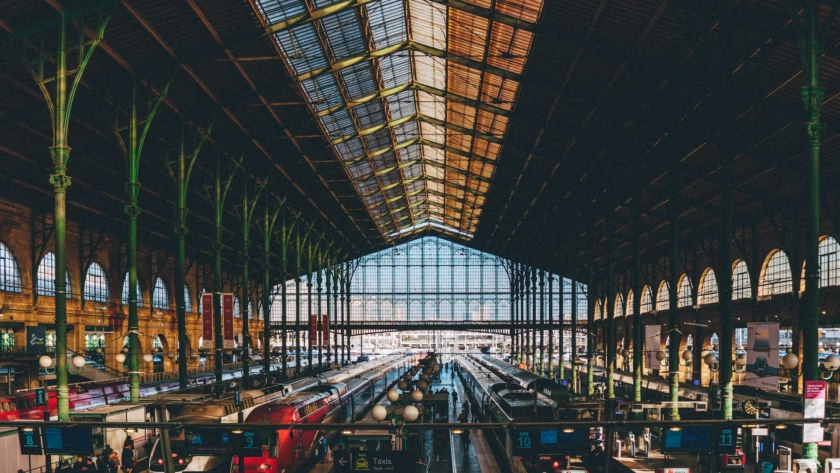
European trains are a popular way to travel. Not only do they offer a practical way to access busy cities across Europe, but they also provide a chance to sightsee, visit landmarks and travel from one main city to another.
Hundreds of millions of passengers pass through major rail hubs every year, with many of the big cities home to more than one of Europe’s busiest train stations.
In this article, we reveal the latest data on passenger numbers across Europe’s top train stations, highlight which countries dominate the rankings and how train travel compares to other modes of transport.
Key statistics
- Paris Gare du Nord is Europe’s busiest train station, welcoming around 257 million passengers annually, while Hamburg Hauptbahnhof follows with 201 million travellers despite operating on only 12 platforms, highlighting one of the most efficient layouts in Europe.
- Rome Termini, Munich Hauptbahnhof, and Paris Gare du Nord each have 32 platforms, the highest total in Europe.
- Paris accumulates 144 platforms across its five main stations, more than any other city in Europe.
- Germany has nine of Europe’s top 20 busiest train stations, collectively handling more than one billion passengers a year.
- Russia, Germany, and France lead with 124 billion, 102 billion, and 96 billion, respectively, in rail passenger kilometres (measured by distance travelled).
- Greece recorded the largest year-on-year growth in rail passengers at 75%, while Germany and Italy saw slight declines of 5.6% and 6.6%, respectively.
Europe’s busiest train stations ranked
Europe’s largest train stations carry enormous volumes of travellers every year. Collectively, the 10 busiest stations handle around 1.5 billion passenger journeys annually, roughly the equivalent of every resident of Europe taking more than two train journeys per year.[1]
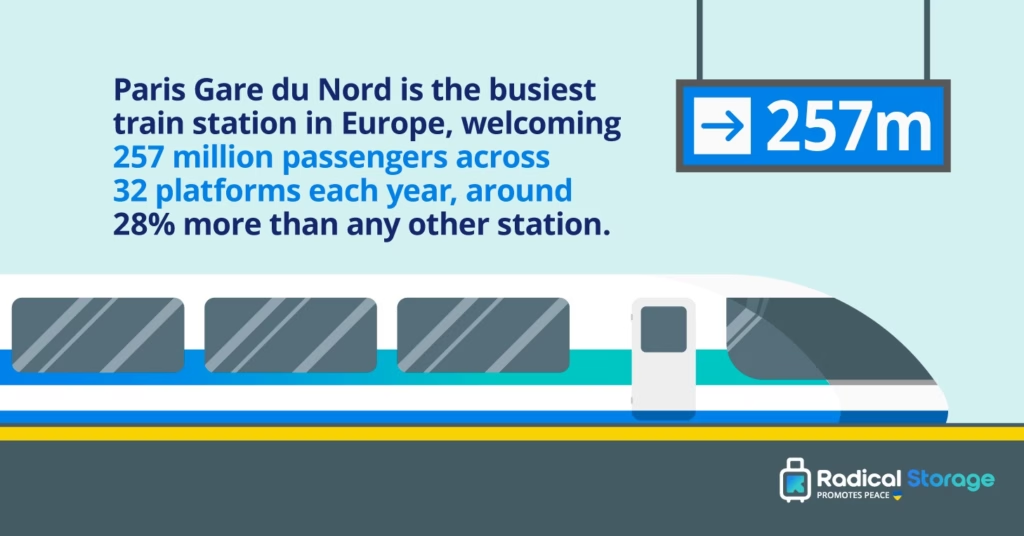
Paris Gare du Nord tops the list, welcoming an estimated 257 million passengers each year across 32 platforms. That’s around 28% more traffic than Hamburg Hauptbahnhof, Europe’s second-busiest station. Paris Gare du Nord links local RER and Metro services with international trains, including Eurostar to London and Thalys to Brussels and Amsterdam.
Frankfurt (Main) Hauptbahnhof follows closely with 164 million passengers, reflecting its role as one of Germany’s main long-distance interchanges. Zürich Hauptbahnhof ranks fourth, with just under 160 million passengers, and serves as Switzerland’s busiest transport hub, with major connections across the country and into Germany and Austria.
In fifth place, Paris Gare Saint-Lazare handles about 152 million passengers, driven largely by heavy commuter traffic from Normandy into the French capital. Munich Hauptbahnhof and Berlin Hauptbahnhof continue Germany’s strong showing, ranking sixth and seventh, respectively, with around 150 million and 120 million passengers.
France and Germany dominate the rankings, together accounting for eight of Europe’s 10 busiest stations, while Switzerland, Italy and Spain each claim one spot.[2]
| Europe’s Busiest Train Stations | ||||
| Rank | Station | City | Country | Annual Passengers (millions) |
| 1 | Paris Gare du Nord | Paris | France | 257 |
| 2 | Hamburg Hauptbahnhof | Hamburg | Germany | 201 |
| 3 | Frankfurt (Main) Hauptbahnhof | Frankfurt | Germany | 164 |
| 4 | Zurich (Main) Hauptbahnhof | Zurich | Switzerland | 160 |
| 5 | Paris Gare Saint-Lazare | Paris | France | 152 |
| 6 | Munich Hauptbahnhof | Munich | Germany | 150 |
| 7 | Berlin Hauptbahnhof | Berlin | Germany | 120 |
| 8 | Paris Gare de Lyon | Paris | France | 113 |
| 9 | Rome Termini | Rome | Italy | 107 |
| 10 | Madrid Puerta de Atocha-Almudena Grandes | Madrid | Spain | 100 |
Source:[2]
Train stations with the most platforms
The number of platforms may signify the scale of operation at a train station, the volume of passengers, the number of journeys and the size of the station.
Rome Termini, Munich Hauptbahnhof and Paris Gare du Nord each have 32 platforms, the highest total in Europe.
Again, Paris appears multiple times on the list, totaling 144 platforms across all five stations. This may help explain why the city’s rail hubs also feature prominently among Europe’s busiest stations.
| European Train Stations with the Most Platforms | ||||
| Rank (by Platforms) | Station | City | Country | Platforms |
| 1 | Rome Termini | Rome | Italy | 32 |
| 1 | Munich Hauptbahnhof | Munich | Germany | 32 |
| 1 | Paris Gare du Nord | Paris | France | 32 |
| 4 | Paris Gare de l’Est | Paris | France | 29 |
| 4 | Frankfurt (Main) Hauptbahnhof | Frankfurt | Germany | 29 |
| 6 | Bologna Centrale | Bologna | Italy | 28 |
| 6 | Paris Gare Montparnasse | Paris | France | 28 |
| 6 | Paris Gare de Lyon | Paris | France | 28 |
| 9 | Paris Gare Saint-Lazare | Paris | France | 27 |
| 10 | Zürich Hauptbahnhof | Zürich | Switzerland | 26 |
Source: [3]
Volume of passengers vs number of platforms
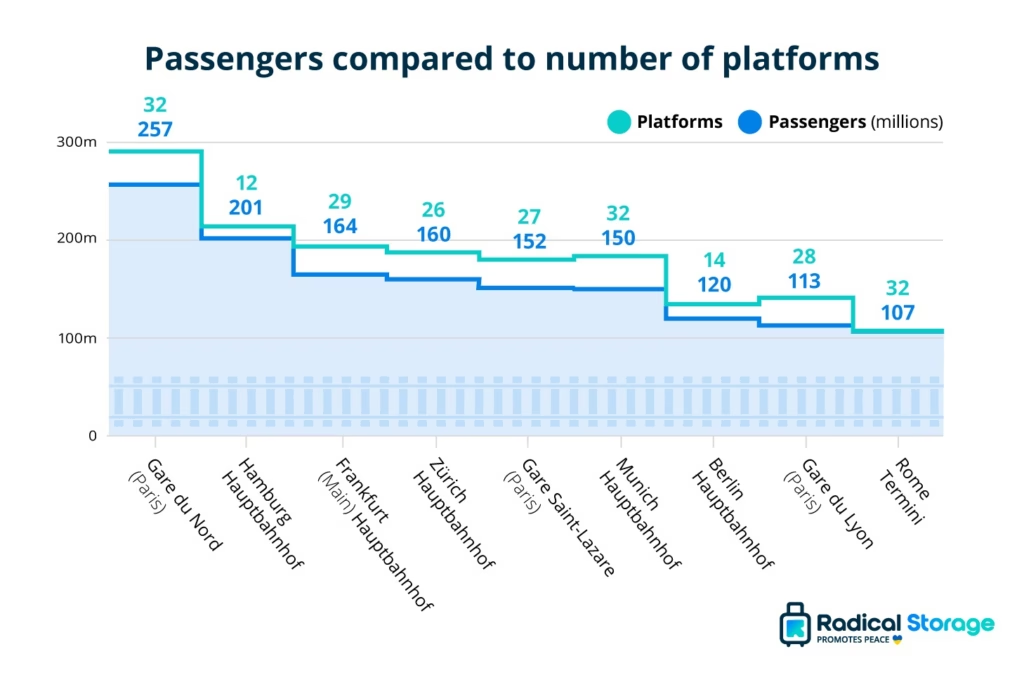
Although the number of platforms at a train station may give you an idea of the size and busyness of a station, it doesn’t always go hand-in-hand with the volume of passengers. Five of Europe’s busiest stations also rank among those with the most platforms, while the remaining five demonstrate that high passenger volumes don’t always depend on infrastructure size.[2][3]
Source: [2][3]
Although there’s a general pattern in the number of passengers per platform, more platforms don’t necessarily mean more passengers.
The busiest European train stations by country
Across Europe, a small number of countries account for most of the continent’s rail traffic. France and Germany dominate the rankings, while Switzerland, Italy and the United Kingdom also feature in the top 20 busiest train stations in Europe.
France
France’s rail network is anchored by Paris, the most visited city in Europe. The capital is home to three of Europe’s top 20 busiest train stations, led by Paris Gare du Nord and Gare de Lyon.
Gard du Nord welcomes 257 million passengers annually, serving regional RER lines, domestic TGV routes, and international services including Eurostar to London and Thalys to Brussels and Amsterdam.
Other stations in Paris include Gare Saint-Lazare (152 million) and Gare de Lyon (113 million).[3]
Germany
Germany has the most stations in Europe’s top 20, with nine entries ranging from Hamburg to Berlin. Together, they handle more than one billion passengers each year, highlighting the strength and decentralisation of Germany’s rail network. Hamburg Hauptbahnhof tops the list with around 201 million passengers annually, followed by Frankfurt (Main) Hauptbahnhof with 164 million, Munich Hauptbahnhof with 150 million, and Berlin Hauptbahnhof with 120 million.
At the lower end of the rankings, Berlin Gesundbrunnen still records over 74 million passengers per year, while Hannover, Stuttgart, and Berlin Ostkreuz each serve between 90 and 95 million travellers, demonstrating how Germany’s busiest routes are spread across multiple regions rather than concentrated in a single capital.[3]
Italy
Italy has the third most stations in Europe’s top 20 busiest, with three major hubs collectively handling more than 250 million passengers each year. Rome Termini leads with around 107 million passengers annually, serving as the main interchange for both Frecciarossa and Italo high-speed services linking the capital with Milan, Naples and Florence.
Milan Centrale follows with roughly 78 million passengers, acting as a gateway between Italy and Switzerland via international routes through the Alps. Turin Porta Nuova, handling about 71 million passengers per year, connects northern Italy’s industrial heartlands with the rest of the country, reinforcing Italy’s position as one of Europe’s key rail corridors.[3]
Switzerland
Switzerland’s rail network remains one of the most heavily used in Europe, with two major hubs handling more than 230 million passengers each year. Zürich Hauptbahnhof leads with around 160 million passengers annually, serving as the main interchange for routes across Switzerland, Germany and Austria. Bern Hauptbahnhof follows with about 70 million passengers, linking the capital region with Zurich, Lausanne and Geneva. Together, these stations highlight Switzerland’s exceptional rail connectivity and its per capita passenger usage among the highest in the world.[3]
European countries with the most rail passengers (by distance traveled)
Measured by total passenger kilometres, which reflect the combined distance travelled by all rail passengers, these countries represent Europe’s busiest rail networks. Russia, Germany and France lead the way, followed by Italy, Poland and Switzerland.
Russia tops the list with around 124 billion passenger kilometres, which is expected given its size and extensive cross-continental rail network spanning both Europe and Asia. Most of its passenger traffic, however, is concentrated in European Russia, where routes between Moscow and St Petersburg remain among the busiest anywhere in the world. Within the European Union, Germany leads with 102 billion passenger kilometres, followed by France at 96 billion, reflecting strong demand for high-speed and commuter rail. Switzerland’s presence in the top 10, despite its smaller population, highlights exceptionally high rail usage per person.[4]
| Top 10 European Countries For Railway Passenger Traffic | ||
| Rank | Country | Per Million Passenger Kilometers |
| 1 | Russia | 123,940 |
| 2 | Germany | 102,380 |
| 3 | France | 96,160 |
| 4 | Italy | 59,110 |
| 5 | United States | 32,080 |
| 6 | Poland | 22,120 |
| 7 | Ukraine | 21,400 |
| 8 | Switzerland | 21,190 |
| 9 | Kazakhstan | 18,980 |
| 10 | Netherlands | 18,840 |
Source:[4]
Rail Growth and Year-on-Year Change
Rail travel across Europe remained largely stable between 2023 and 2024, though growth varied by country.
Greece recorded the largest annual increase, up 75%, reflecting the restoration of key routes after previous network disruption. Bulgaria (+12%) and Sweden (+5.6%) also saw healthy growth, alongside smaller gains in Romania (+3% )and Estonia (+5%).
In contrast, rail travel fell in several major markets, including Germany (-5.6%), Italy (-6.6%) and Switzerland (-7.1%). Across the EU-27, train travel dropped by an average of 4.2%, while car journeys increased by about 2.5% and air travel declined by more than 10%.
These results highlight how Europe’s rail usage is still adjusting after years of fluctuation, with southern and eastern networks expanding while some central systems experienced short-term slowdowns.[4]
| European Train Stations Growth | |
| Country | Trains YOY |
| Greece | +75.00% |
| Bulgaria | +11.76% |
| Sweden | +5.56% |
| Estonia | +5.00% |
| Romania | +3.03% |
| Belgium | 0.00% |
| Denmark | 0.00% |
| Lithuania | 0.00% |
| Poland | -1.30% |
| Portugal | -2.78% |
| Netherlands | -2.75% |
| Slovakia | -2.60% |
| France | -3.30% |
| Czechia | -3.90% |
| Austria | -4.76% |
| Slovenia | -4.76% |
| Germany | -5.62% |
| Italy | -6.56% |
| Switzerland | -7.14% |
| Norway | -11.11% |
| Spain | -15.52% |
| Ireland | -15.38% |
| Hungary | -16.05% |
| Luxembourg | -17.78% |
| Croatia | -22.73% |
Source:[2]
Traveling by rail vs other modes of transport
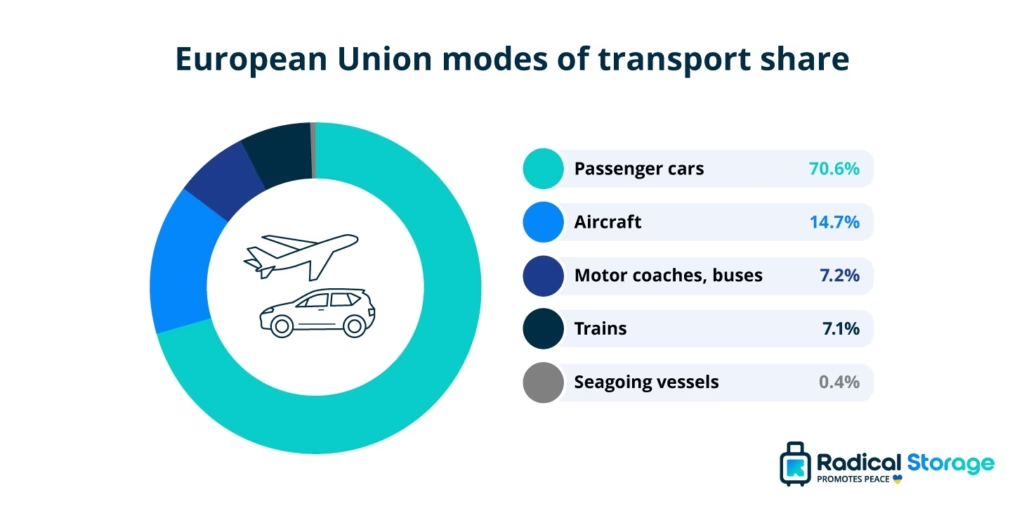
According to Eurostat, the European Union (EU) saw a 0.3% increase in the share of train transport in 2023, with rail accounting for 7.1% of total inland passenger-kilometres, up from 6.8% in 2022. While that represents steady growth, it remains small compared with other modes of travel across Europe.
Passenger cars continue to dominate, carrying 70.6% of all passenger-kilometres, followed by aircraft at 14.7% and buses or coaches at 7.2%. Seagoing vessels account for just 0.4% of all inland transport activity.
Overall, car travel still defines the European transport landscape, but the gradual rise in rail’s share reflects growing investment in sustainable mobility, high-speed links, and commuter infrastructure.[5]
Source:[5]
Rail usage by country
Countries such as Switzerland (18.2%), the Netherlands (10.9%) and Austria (10.5%) record the highest share of passengers by rail. This could be down to a number of reasons, including the density of the rail coverage on those locations, the locations accessible by train and ease-of-use.[5]
Switzerland’s trains are becoming faster and more frequent, while offering a record number of connections. The country is also known for having the world’s densest rail network, covering 3,241 miles.[6][7]
It’s no surprise that transport by car is the most popular mode of transport across all countries, although it is lowest in Cyprus, Hungary and Switzerland.
| Countries | Train | Passenger cars | Motor coaches, buses and trolley buses | Seagoing vessels | Aircraft |
| Belgium | 8.3 | 71 | 9.1 | 0 | 11.6 |
| Bulgaria | 1.7 | 63 | 6.3 | 0 | 29 |
| Czechia | 7.7 | 69.2 | 9 | N/A | 14.1 |
| Denmark | 6.9 | 71.1 | 8.9 | 1.9 | 11.1 |
| Germany | 8.9 | 74.7 | 5.8 | 0.1 | 10.5 |
| Estonia | 2 | 71.4 | 12 | 2.3 | 12.4 |
| Ireland | 2.6 | 69.5 | 15.4 | 0.2 | 12.3 |
| Greece | 0.4 | 63 | 10.9 | 1.8 | 23.9 |
| Spain | 5.8 | 66.4 | 6.9 | 0.5 | 20.5 |
| France | 9.1 | 68.6 | 4.3 | 0.3 | 17.7 |
| Croatia | 2.2 | 45.4 | 6.6 | 2.4 | 43.5 |
| Italy | 6.1 | 74.7 | 9 | 0.6 | 9.7 |
| Cyprus | : | 60.6 | 12 | 0 | 27.4 |
| Latvia | 3.3 | 71.6 | 10.1 | 0.2 | 14.9 |
| Lithuania | 1 | 85.7 | 6.4 | 0.1 | 6.9 |
| Luxembourg | 4.5 | 74.6 | 11.1 | N/A | 9.8 |
| Hungary | 8.1 | 61.3 | 11.8 | N/A | 18.7 |
| Malta | : | 72.1 | 15.8 | 2 | 10 |
| Netherlands | 10.9 | 77.1 | 2.4 | 0.2 | 9.4 |
| Austria | 10.5 | 59.2 | 7.3 | N/A | 23 |
| Poland | 7.7 | 74.3 | 8.5 | 0.1 | 9.4 |
| Portugal | 3.6 | 74 | 6.3 | 0 | 16.1 |
| Romania | 3.3 | 66.1 | 11.9 | 0 | 18.7 |
| Slovenia | 2.1 | 69.6 | 9.7 | 0 | 18.6 |
| Slovakia | 7.7 | 65.3 | 10.4 | N/A | 16.6 |
| Finland | 6.5 | 76.4 | 9.1 | 2.1 | 5.9 |
| Sweden | 9 | 69.3 | 6.5 | 1.3 | 13.9 |
| Norway | 4.5 | 75.4 | 4.8 | 0.8 | 14.6 |
| Switzerland | 18.2 | 62.4 | 5.5 | N/A | 14 |
| Source:[5] |
* N/A is placed in cells where data is unavailable
Sources
- Worldometers. “Europe Population (Live),” https://www.worldometers.info/world-population/europe-population.
- Consumer Choice Center. “European Railway Station Index 2025,” https://consumerchoicecenter.org/european-railway-station-index-2025/.
- Brilliant Maps. “Busiest Train Stations in Europe,” https://brilliantmaps.com/busiest-train-stations-in-europe/.
- ReportLinker. “European Railway Transport Market Dataset,” https://www.reportlinker.com/dataset/6a8bb96e83f9d63103df54814faeada7d4896bfb.
- Eurostat. “Modal Split of Passenger Transport in Europe,” https://ec.europa.eu/eurostat/databrowser/view/tran_hv_ms_psmod__custom_12806233/bookmark/table?lang=en&bookmarkId=d1c78a12-ff20-4547-8418-f6556000d5c6&c=1725880647626.
- SwissCommunity. “Switzerland Has the World’s Densest Rail Network,” https://www.swisscommunity.org/en/news-media/swiss-revue/article/switzerland-has-the-worlds-densest-rail-network.
- Railbookers. “7 Interesting Facts About Switzerland’s Train System,” https://www.railbookers.co.uk/blog/7-interesting-facts-about-switzerlands-train-system.
